


Colon Cancer and Fatty Liver Disease
The American Cancer Society estimated approximately 154,000 new cases of colorectal cancer in 2025. Because colorectal cancer often presents with few early warning signs, it is frequently diagnosed after the optimal window for early prevention has passed. Eisenhower Health gastroenterologists are working to educate patients on the importance of early screening and proactive measures to decrease the likelihood of advancement of colon polyps to cancer. The American Cancer Society reports that increased adoption of screening practices and lifestyle modi?cations have signi?cantly reduced colorectal cancer—related deaths since the mid-1980s.
Likewise, Eisenhower Health gastroenterologists are working to address one of the leading causes of liver disease worldwide: metabolic dysfunction—associated fatty liver disease (MAFLD). Steatosis (fat buildup in the liver) can lead to in?ammation and ?brosis of the liver, resulting in chronic liver disease (metabolic-associated steatohepatitis or MASH). Risk factors for this include metabolic issues such as obesity, diabetes or insulin resistance. Poor diet, sedentary lifestyle and genetics also play a role. Physicians have found that if caught early enough and with lifestyle modi?cation and proper monitoring, patients are lowering their chances of developing chronic liver disease and the harmful complications of liver cirrhosis.
Read on to learn more about the latest developments in treatment and prevention of both colon cancer and liver disease.
EXPERT TEAM
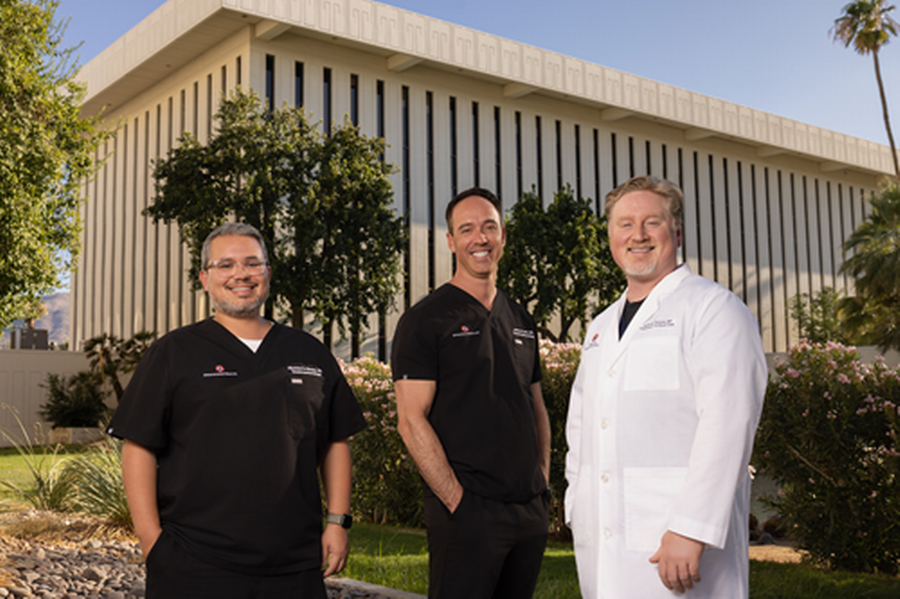
- James Conti, MD, a Board Certi?ed Gastroenterologist, attended Ross University School of Medicine in Dominica, followed by his internship, residency in Internal Medicine and fellowship in Gastroenterology at Albany Medical Center. He has practiced at Eisenhower for 15 years.
- Ulysses Rosas, MD, a Board Certi?ed Gastroenterologist, moved to the Coachella Valley at an early age and attended local schools. Dr. Rosas earned his bachelor’s degree and doctorate in medicine at Stanford University in Palo Alto, followed by his residency in Internal Medicine at Stanford Medicine Health Care. He completed his fellowship in Gastroenterology at Cedars-Sinai Medical Center before returning home to the Coachella Valley.
- Justin Thomas, MD, Board Certi?ed in Pulmonary Disease, Interventional Pulmonology, Critical Care Medicine and Internal Medicine, moderated the discussion.
DR. THOMAS: Let’s start with colon cancer. What is the incidence or rate of diagnosis for colon cancer in the United States?
DR. ROSAS: Colorectal cancer is the third most common cancer in the United States, more common in men than women, but third amongst malignancies in the U.S.
DR. THOMAS: What are the risk factors associated with colon cancer?
DR. ROSAS: Existing non-modifiable risk factors include underlying genetics or hereditary syndromes that increase the risk of developing colon cancer. We evaluate those through learning the family histories of colon cancer, particularly those with first-degree relatives affected by colon cancer. Modifiable risk factors include being overweight, excessive alcohol consumption, smoking, poor diet, and a sedentary lifestyle, all of which can increase the risk of colon cancer.
DR. THOMAS: Is there anything that I could do from a lifestyle standpoint to decrease my risk of developing colon cancer?
DR. ROSAS: There’s a lot of data that suggests doing everything that we can to stay healthy in terms of being physically active and eating a healthy diet can help. Specifically, diets high in fiber, vegetables and fruit. Populations that increase fiber intake tend to have lower risks overall of colon cancer. Also, there’s some evidence that Vitamin D supplementation is protective.
DR. THOMAS: Does alcohol consumption or smoking increase risk for colon cancer?
DR. ROSAS: Yes, alcohol consumption and smoking generally increase the risk for different cancers and it’s also true for colon cancer. Alcohol consumption that is more than a few drinks at a sitting, or daily, is excessive. Any amount of smoking increases the overall risk for colon cancer.
DR. THOMAS: Dr. Conti, what are some symptoms of colon cancer?
DR. CONTI: Unfortunately, in the early stages of colon cancer there are not a lot of symptoms, which is why we have developed arduous screening techniques to pick it up in an early stage. What we start to see in late-stage cancers is bleeding or anemia, or depending on the location of the cancer, patients may have obstruction symptoms. Abdominal cramping and weight loss is common with a lot of cancers, but more so in the advanced stages. That’s why screening tools have been developed to find possible cancers much earlier when it’s treatable.
DR. THOMAS: Unfortunately, with colon cancer, unless you are screening, it is caught more in the late stages, much like lung cancer. Screening for colon cancer is extremely important. What is the prognosis of patients in general with colon cancer?
DR. CONTI: Earlier staging is associated with a better prognosis and chance for a surgical cure is the best-case scenario; however, once we start seeing penetration into the wall or localized [surrounding tissue or lymph node involvement] or distant spread, chances for a cure decrease. Late-stage cancers are faring better with the newer chemotherapies available. In the past, Stage 4 colon cancer survival beyond a year was infrequent. Now, we’re seeing some patients with Stage 4 disease living several years and beyond after diagnosis.
DR. THOMAS: Could you explain colon polyps and their relation to cancer?
DR. ROSAS: When we find polyps, they come in two categories: hyperplastic or inflammatory polyps, which are essentially completely benign types of polyps without any precancerous potential, and adenomatous polyps, which can progress to colon cancer. But when we say progress to colon cancer, that takes several years. Progression from a polyp to colon cancer can take anywhere from 10 to 20 years. That’s why we do colonoscopies in large intervals of time of three, five, seven, 10 years; however, the slow progression from polyp to cancer is also a good thing for us. It gives us a lot of time to intervene where we can.
DR. CONTI: This is one of the few screening tests that potentially is also curative at the time of diagnosis. That’s why we’re always encouraging people to get [a colonoscopy] done at the appropriate interval and get your screening test when you’re eligible.
DR. THOMAS: What are the current recommendations for colon cancer screening and, in particular, in patients who have a family history of colon cancer?
DR. ROSAS: The colon cancer screening guideline for those who are at an increased risk for colon cancer - family histories of cancer or underlying conditions like inflammatory bowel disease - is a colonoscopy at a minimum of every five years. For those with a family history, procedures start at age 40, or 10 years before the family member was diagnosed. For the general population with an average risk of colon cancer, screening is recommended to start at age 45.
DR. THOMAS: Is lowering the age of recommended screening from 50 to 45 a response to an uptick in colon cancer in younger patients?
DR. ROSAS: While gastroenterologists are seeing an uptick in rates of early-onset colon cancer, the younger population is still not the biggest percentage of patients with colon cancer; however, compared to what we were seeing 20 years ago, there are more people in their 40s and 50s being affected by colon cancer, which is why the recommendation changed to start screening at age 45 years old. As Dr. Conti mentioned, scheduling screening tests to detect either advanced polyps or early cancer is very important.
DR. THOMAS: Is there any data as to what is attributed to the increase of incidences of colon cancer in a younger population?
DR. ROSAS: That’s an active area of research, but some of the early findings suggest that our modifiable risk factors, like a Western diet high in processed foods and sugar and sedentary lifestyle, are contributing to some of these early-onset colon cancers over the course of the last several decades. People aren’t eating as healthy and aren’t as active.
DR. THOMAS: Is there a decrease in ?ber in the diet as well?
DR. ROSAS: Most Americans have diets that are low in fiber. In general, focusing on increased dietary consumption of fiber is important; however, a fiber supplement can also be helpful and is an important part of your colon health.
DR. THOMAS: What are some of the screening tools used at Eisenhower Gastroenterology Specialty Clinic?
DR. CONTI: The best test is the one that gets done. For patients scared of a colonoscopy (examining the large intestines while the patient is under sedation, with possible extraction of tissue samples or removal of polyps), a stool-based test is a great entry point with the understanding that if it’s a positive result, a colonoscopy is recommended for follow-up. I believe the first entry point should still be a colonoscopy, because we don’t really know a patient’s risk level until we have determined if the patient makes polyps. A lot of times there is no family history, but then polyps are located due to earlier stated modifiable factors. The benchmark should be a colonoscopy to determine if you make polyps or not, and if you don’t fall in that category, then it’s possible to continue with other screening techniques going forward. Other options include stool-based testing, which looks for occult blood, and fecal DNA testing, which looks for microscopic DNA associated with polyps and cancer. Stool-based testing has gained popularity; however, false positive rates are high, from 35% to 46%. Unfortunately, patients will experience anxiety and want to rush in and get a colonoscopy. The good news is the majority of those patients are not diagnosed with cancer. Also, if patients have some of the high-risk factors, the stool-based testing is not sensitive enough to pick up early polyp formation.
DR. THOMAS: Does it change the interval of screening when polyps are found?
DR. CONTI: The size and type of polyp determine surveillance. It could be five years, three years, sometimes even six months, depending on the techniques used to remove the polyp. Generally speaking, larger polyps and/or advanced cells seen under the microscope would require surveillance sooner.
DR. THOMAS: AI integration is entering a lot of medical practices. Is AI used in colon cancer screening?
DR. CONTI: It’s still in the very early stages. The software - similar to facial-recognition software - is looking at the same screen we’re looking at and processing the data, looking for abnormalities of the mucosal surfaces during the actual colonoscopy inspection process. We’re looking for abnormal lesions or surface areas, and while we can see some of the areas, some of the subtle polyps or flat regions with just a millimeter in thickness are difficult to identify at times. If you’re not carefully withdrawing the scope and watching closely, the subtle polyps may be missed, which is where AI is starting to assist with detection of these types of lesions.
DR. ROSAS: The data is promising in that more adenomatous colon polyps are detected. Those are the polyps that in several years become colon cancer. It all depends on the endoscopist’s skill level and how many polyps are found per colonoscopy, which is some of the quality measures that we as gastroenterologists have for ourselves. We should be finding polyps at least one-third of the time in screening colonoscopies and more for those who have a history of previous polyps.
DR. THOMAS: That explains the possible bene?ts of utilizing AI. What would be the limitations?
DR. ROSAS: Any test with an increased sensitivity for detection could present false positives. Integrating AI increases the time of the procedure, which has its own pluses and minuses. Lastly, it’s a very costly tool to implement in a practice setting, which is why it’s mostly used in academic centers. It’s a helpful tool in training to help identify what polyps look like. But as a practitioner develops more experience, the better he or she is at detecting subtle lesions.
Newer colonoscopes with high-definition white light are a much better tool than what was used about 10 years ago. It’s part of the reason why in more recent iterations of colon cancer screening guidelines, the interval of testing can be increased. It used to be standard that if a polyp was found, the patient returned in five years. Now, in the case of a small polyp, the patient might not need to come back for seven years. Part of that is the better-quality standards we have for our own screening procedures and the better technology we have with this high-definition white light scopes and different light modalities to detect subtle lesions or flat polyps.
DR. THOMAS: In what percentage of colonoscopies is cancer found?
DR. ROSAS: We find it 5% or less of the time during a screening test.
DR. CONTI: We do a lot of procedures for the purpose of screening the general population, even those at low risk. Because of this, the cancer detection is not that high because of how many healthy patients that we’re also taking a look at for prevention.
DR. THOMAS: Patients are often apprehensive about the preparation for a colonoscopy. Have there been any advancements in the preparation to make it easier for patients?
DR. ROSAS: While there are a lot of advances in bowel prep, the end result is still the same - to make sure that you’re as clean as possible. There are certainly a number of different options. Now, smaller-volume preps are essentially 75% less of the volume to drink. Also, there are pill formulations, flavored bowel preps, and even flavored pills. Part of the option depends on what your insurance has on formulary. We would love to give patients whatever they want, but out-of-pocket cost could be the determining factor. Most of the preps work well, assuming that the patient doesn’t have issues with chronic constipation.
DR. THOMAS: For those who are eligible for colon cancer screening, what percentage of eligible patients actually get screened?
DR. CONTI: Around 60% in California, depending on region and demographics.
DR. ROSAS: Eisenhower Health has integrated direct access to expand a patient’s access to a screening colonoscopy. In addition to a patient’s primary care provider referring the patient for the test, the patient can now directly schedule the colonoscopy procedure. That direct access has allowed us to do more screening procedures and get patients scheduled in more reasonable time frames.
DR. THOMAS: Let’s discuss non-alcoholic fatty liver disease (NAFLD) or non-alcoholic steatohepatitis (NASH). How do these two conditions affect patients?
DR. ROSAS: Fatty liver disease, now termed metabolic dysfunction-associated fatty liver disease (MAFLD), is a metabolic disorder often associated with metabolic issues like being overweight, or having diabetes or insulin resistance.
DR. CONTI: Fatty liver is fat depositing into the liver organ and the good news is for most people, it’s a benign condition, somewhere between 5 and 10% is where the condition shifts to a more significant clinical condition. Current estimates are that 30% of the U.S. population may have fatty liver and 5 to 10% of that population is a large number, somewhere between 5 and 10 million people who could develop complications, such as end-stage cirrhosis (severe, permanent scarring) from fatty liver. We’ve seen now that the near-eradication of Hepatitis C (infection that causes liver swelling that can lead to serious liver damage) with pharmaceuticals is being overshadowed by fatty liver disease. Research has shifted to fatty liver disease as it’s the primary reason for a liver transplant in the U.S.
DR. THOMAS: Can patients reverse a fatty liver diagnosis through diet, exercise or other means?
DR. ROSAS: Fatty liver disease is on a continuum of progression. Fats accumulating in the liver may lead to inflammation, which is what would ultimately damage the liver. There’s a lot of ways to grade that from mild to severe fatty liver accumulation and from mild to advanced liver fibrosis, or liver scarring.
One of the reasons why there’s so much interest to develop good therapies is fibrosis is reversible, whereas end-stage liver disease, or cirrhosis, is not. Treatment is lifestyle modification - eating a healthy diet and physical activity. Reversal of liver fibrosis is achieved with at least 10% weight loss. A patient who’s overweight and loses 10% of that weight, will see improvement in the fibrosis scores.
DR. CONTI: It’s about detection. Detection tests figure out which patients are in the higher-risk categories and are developing scarring. There’s been a variety of different tools more readily available between blood tests that look at different measures of inflammation or one of the tools we have in our office, which is a FibroScan®. The scan utilizes ultrasound mechanical vibration wave technology to look at the density of the liver and give a gross estimation of how much fat is potentially there. For a FibroScan, patients come in with an empty stomach and we can do the test within about 15 minutes. A provider will read the report and gauge where the patient may stand on the continuum of disease. Newer therapies such as GLP-1 drugs (glucagon-like peptide-1 receptor agonists) are being studied for their effectiveness in reversing fibrosis, and showing a lot of promise.
DR. ROSAS: In the past year, there is one medication, resmetirom (Rezdiffra™), that is specifically approved for people who have moderate to severe liver fibrosis with fatty liver but it’s really limited in use to that subset of people, which is why diet and exercise is still a mainstay treatment for fatty liver no matter what stage of fatty liver - mild, moderate or severe. And for those people who just have mild fibrosis, that’s still the treatment course.
DR. CONTI: The newly approved medication has great benefits but only a small percentage of patients will qualify for this treatment because it’s currently only approved for the patients with advanced fibrosis. The GLP-1 medications could assist patients in losing the 10% body fat to see a significant difference in their fibrosis. It is exciting because GLP-1s have been effective in getting that 10% loss in a lot of patients who take it even for short courses. And, independent of weight loss, research is showing reversal in scarring as well.
DR. THOMAS: By the time patients are referred to your practice, they are typically diagnosed with fatty liver disease. From a primary care standpoint, is there anything my doctor should do to screen for this diagnosis?
DR. CONTI: Most cases are found incidentally. A patient is getting routine blood work and liver enzyme testing is outside the normal range, which would usually trigger some kind of investigation by the primary care physician. Other times, patients are getting an incidental finding in imaging. That’s why it’s important to bring more attention to the metabolic component and identify those higher-risk patients.
DR. ROSAS: A lot of the identification of patients who are at risk is certainly done by our amazing primary care doctors using scores like the FIB-4 (Fibrosis-4) [non-invasive blood test that uses identifiers to estimate], imaging studies that suggest that there might be fatty accumulation or liver enzymes might be elevated on routine labs. Our go-to tool is the FibroScan, which we spoke about earlier. We’re able to risk stratify these patients and develop a good plan moving forward. But because the treatment is lifestyle change, that’s why it’s a joint effort between gastroenterologists and hepatologists (medical doctors who specialize in the diagnosis, treatment and management of diseases affecting the liver and bile) and primary care doctors.
DR. THOMAS: What does that long-term follow-up look like for patients with MASH or MAFLD, particularly patients with maybe stable disease versus progressive disease?
DR. ROSAS: Whether they see us or their primary care doctor once a year, we are well equipped at counseling patients on healthy lifestyles and physical activity to guide those patients on getting that 10% weight loss. The difference comes in patients who are experiencing MASH [fatty liver disease with liver fibrosis], whom we try to see at least once or twice a year to repeat the FibroScan. We are encouraging the lifestyle changes and repeating the FibroScan at least once a year for the vast majority of these patients, which gives us a good sense of whether things are getting better, staying the same or getting worse. For the patients who are getting worse, we start thinking about what medical therapy might be helpful.
DR. CONTI: The latest developments in medical therapies arrived in the last year. As a practicing gastroenterologist for more than 15 years, I’ve been waiting for data to come out about all the medical therapies available, but it’s really only been diet and lifestyle modification up until now. The fact that we now have an FDA-approved medication and another one probably shortly on the way, is exciting. This latest development will make a difference in the long-range progress of the disease.
DR. ROSAS: It’s an exciting time for us because now we have additional tools to reverse that fibrosis and liver scarring in an effort to prevent people from progressing into end-stage liver disease. Fatty liver is becoming the No. 2 reason why people develop end-stage liver disease in the U.S., alcohol still being No. 1, but fatty liver is quickly rising.
The effects of fatty liver and excess alcohol consumption are compounding, leading to higher rates of chronic liver disease and cirrhosis. We saw this during the COVID-19 pandemic, where alcohol consumption acutely increased. It is important to counsel patients on all aspects of a healthy lifestyle and healthy habits.
DR. THOMAS: Is there a genetic component?
DR. ROSAS: There’s certainly a strong genetic component underlying those issues, involving complex interactions between multiple genes and the different lifestyle factors we have been discussing. These genetic components can influence disease severity and progression.
DR. THOMAS: Can you tell us a little bit about the new outpatient center for Eisenhower Health gastroenterology?
DR. CONTI: Located in Rancho Mirage, the Mirage Endoscopy Center is a joint venture with Eisenhower Health, offering a state-of-the-art, four-room endoscopy center that increases access to more procedures.
DR. ROSAS: One of the amazing things about this new center is that we are focused on doing GI procedures, so largely colonoscopies and upper endoscopies. This focus allows our staff and doctors to excel at all aspects of care involved in performing these procedures. As gastroenterologists, we continuously strive to improve outcomes with respect to people’s digestive health. It is important for all the reasons we have discussed to obtain a referral and make an appointment to come see us in clinic.
To learn more about GI services, visit EisenhowerHealth.org/GI or call 760.568.1234.


