


Upcoming Events
- 20th Annual Community Cancer Awareness Day: Screening for Colon Cancer
SA, Mar 16, 9:30 to 11:30 a.m.
Join our panel of colon cancer experts for this presentation on colon cancer screening guidelines - it just might save your life.
For more information, please call 760-834-3798 or email us at CAreservations@EisenhowerHealth.org Read More
The Connection Between Diabetes and Stroke
M, Mar 18, 1 to 2:30 p.m.
Kathy Cash, RN, and Marielena Cid, MSN, RN, CDCES, PHN
To register online, visit EisenhowerHealth.org/Calendar. Read MoreBariatric Surgery Information
TU, Mar 19, 8 to 9:30 a.m.
Jorge A. Almodovar, MD, Board Certified in General Surgery
To register online, visit EisenhowerHealth.org/Calendar, or call 760-834-3796. Read MoreBlood Drive
TU, Mar 19, 10 a.m. to 3 p.m.
To register online, visit EisenhowerHealth.org/Calendar, or call 800-879-4484. Read MoreDiabetes and Healthy Eating
TU, Mar 19, 2 to 3 p.m.
Marielena Cid, MSN, RN, CDCES, PHN
To register online, visit EisenhowerHealth.org/Calendar. Read MoreCurrent and Innovative Strategies for the Treatment of Common Shoulder and Elbow Injuries
TU, Mar 19, 4:30 to 5:30 p.m.
David Savin, MD, Board Certified in Orthopedic Surgery
To register online, visit EisenhowerHealth.org/Calendar. Read MoreAbnormal Uterine Bleeding and Menopause
TH, Mar 21, 4:30 to 5:30 p.m.
Christopher Hicks, MD, Board Certified in Gynecology
To register online, visit EisenhowerHealth.org/Calendar. Read MoreThe Benefits of Eating Locally
W, Mar 27, 10 to 11 a.m.
Johanna Roberts, Registered Dietitian Nutritionist
To register online, visit EisenhowerHealth.org/Calendar. Read MoreAnorectal and Colorectal Cancer Screenings: A Panel Discussion
W, Mar 27, 4 to 5 p.m.
Jorge Rodriguez, MD, Board Certified in Internal Medicine; Donald Gardenier, NP; and David Russo, Founder, Cheeky Charity
To register online, visit EisenhowerHealth.org/Calendar. Read MoreBariatric Surgery Information
W, Mar 27, 5:30 to 6:30 p.m.
Bobby Bhasker-Rao, MD, Board Certified in General Surgery
To register online, visit EisenhowerHealth.org/Calendar, or call 760-834-3796.
Read More
Reverse shoulder replacement
 “It’s really pretty remarkable.”
Annie Milner, 68, is not one to sit still. She hikes, plays golf, tennis and pickleball. As a young girl, she began swimming, eventually becoming an All American swimmer at UCLA. Other activities she enjoyed in the past include backpacking, skiing and horseback riding. Currently, she’s wrapping up a one-year term as president of Ironwood Country Club. And she is the principal caretaker of her husband, who has multiple sclerosis.
But about ten years ago, the range of motion in her right shoulder began to diminish due to an old injury, limiting her ability to do many of the things she wanted and needed to do.
“I’d had an accident while camping in my late teens and my shoulder came totally out of its socket,” Milner relates. “I was able to shake it back in, and when I saw a doctor, they recommended that I not have surgery because the technique wasn’t very refined at the time.
“Over the years, it would continue to come out of the socket — if I was playing tennis, for example, or if I didn’t tuck and roll when I fell while skiing,” she continues. “With these recurring injuries, my shoulder mobility became less and less. I didn’t have extreme pain, but I couldn’t lift my right arm very high. My golf swing was altered, I couldn’t serve a tennis ball, and I couldn’t brush my hair or reach an overhead shelf. [MORE]
“So I started doing some research and talking to people about my options,” she adds.
Serendipitously, one of these people was Board Certified Orthopedic Surgeon Patrick St. Pierre, MD, a neighbor at Ironwood who is one of the world’s top shoulder specialists and among the first surgeons in the U.S. to perform what’s called a reverse shoulder replacement. He teaches the procedure to other surgeons, has helped design a reverse prosthesis, and is one of six surgeons developing the Mako® robot for the shoulder. Milner scheduled a consultation with him in January 2021.
“X-rays showed that she had severe shoulder arthritis,” says Dr. St. Pierre, who is Director of Shoulder and Elbow Surgery at Eisenhower Desert Orthopedic Center. He also reviewed a 2017 MRI that revealed rotator cuff changes. “In cases like this, we first recommend conservative treatment like injections or physical therapy, but she’d already been through that with other providers. So, surgery was clearly indicated — specifically, a reverse shoulder replacement.”
Dr. St. Pierre explains:
“Prior to fifteen years ago, all shoulder replacements were what’s called anatomic shoulders — we’d replace the ball-and-socket joint, recreating the normal anatomy,” he says. “We’d put a plastic cup where the socket used to be and attach a metal ball to the top of the upper arm bone, the humerus.
“If the rotator cuff healed perfectly and the anatomy of the bone was good, then people could have great results,” he continues. “But in someone with bad arthritis, sometimes the bone on the cup portion wears away, or rotator cuff injuries interfere with the shoulder’s function. So, the shoulder replacement won’t work well and loosens over time.
“When I saw Annie, she already had severe deformity of the socket,” Dr. St. Pierre says. “If I put in a plastic liner, it wouldn’t be in the correct orientation to allow the shoulder to function. Also, because the joint would be unbalanced, the ball would fight against that plastic cup and eventually loosen, causing pain and possibly infection.”
In a reverse shoulder replacement, however, the orientation of the ball and socket are reversed (hence the name of the procedure). The metal ball is affixed to the socket and the plastic socket implant is affixed to the top of the humerus. This design has more stability, and shoulder motion is controlled by the deltoid muscle instead of the rotator cuff.
This makes reverse shoulder replacement an ideal choice when an arthritis-damaged shoulder needs new surfaces but doesn’t have sufficient healthy soft tissue to support stabilization and movement. In fact, more than 70 percent of shoulder replacements in the U.S. today are reverse procedures. Notably, 90 percent of Dr. St. Pierre’s surgeries are reverse shoulder replacements, largely due to the prevalence of bony deformity and rotator cuff tears in the desert’s older patient population.
Milner underwent reverse shoulder replacement surgery in February 2021. She admits that the first few days post-op were difficult.
“Once the anesthesia wore off, I was in a lot of pain because I couldn’t take painkillers, only Tylenol,” she says. “The office had recommended that I get an ice machine prior to my surgery and having that for icing my shoulder was a lifesaver.”
She also carefully followed the post-op physical therapy regimen Dr. St. Pierre recommended.
“Therapy is very important, so on our website we have a video program in which my physician assistant and I demonstrate the exercises we want patients to do for five minutes at a time, five times a day,” he says.
“For the first couple of months after surgery, an hour of therapy at a time is way too long and twice a week isn’t frequent enough. So we provide an at-home program which, if patients do faithfully, their recovery can be incredible. If patients need additional help, or want specified therapy, we involve our physical therapists later in the process.”
Milner can attest to that.
“I’m doing great,” she says. “I can play pickleball, golf, tennis, swim and paddleboard. I can do pretty much anything I want and all the things I need to do in day-to-day life. It’s really pretty remarkable, and I’m very, very pleased with the results of the surgery.”
“That’s really the point of it all, to be able to live your life without pain and to be able to do the things you want to do,” Dr. St. Pierre says, referring to reverse shoulder replacement as well as orthopedic surgery in general. And he knows whereof he speaks: he had both hips replaced three years ago and his rotator cuff repaired just five weeks before we spoke.
“The goal is to help people have happy lives that are fulfilling,” he adds.
For more information or to contact Eisenhower Desert Orthopedic Center, call 760.568.2684 or visit EisenhowerHealth.org/EDOC.
Putting His Heart Into It
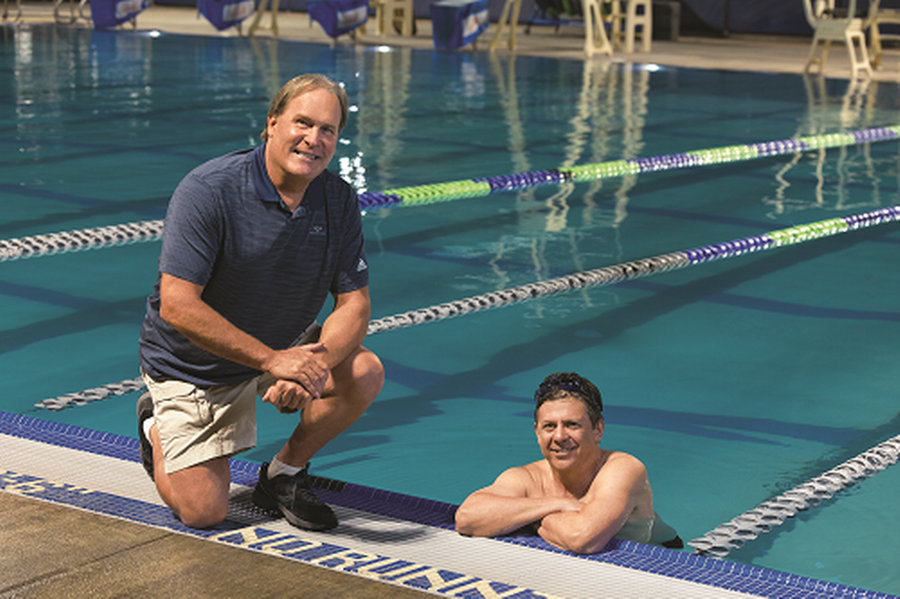 A cardiologist perfects his swim skills
Board Certified Cardiologist James Fitts, MD, listens to a lot of heartbeats in the course of a busy week. But when he’s doing laps in the Palm Desert Aquatic Center pool, Eisenhower’s Section Chief of Cardiology is only focused on his own heartbeat.
For nearly nine years, Dr. Fitts has been perfecting his freestyle stroke with Masters Swim Coach Ben Hobbins. As of this writing, Dr. Fitts was training for his thirtieth triathlon, the Iron Man 70.3 in Indian Wells/La Quinta in December 2023. This arduous event includes a 1.2 mile swim, 56 mile bike ride, and a 13.1 mile run.
Dr. Fitts comes from what he calls “a genetic pool of runners.” In fourth grade, he could complete a 10K. He ran all through high school, college, medical school, and his internship and residency, participating in many marathons along the way. While working at Dartmouth-Hitchcock Medical Center in New Hampshire, Dr. Fitts took up biking. As his rides through the picturesque New England countryside grew more frequent, he realized he was just “one sport away from being able to compete in triathlons.” [MORE]
Always a self-starter, Dr. Fitts decided to teach himself to swim. He participated in two triathlons in New England before moving cross country to join Eisenhower Health. His running and biking times were competitive, but swimming was another story. The first time he took part in a triathlon, he was last out of the water.
Once settled in the Coachella Valley, Dr. Fitts signed up for Palm Desert’s Y Be Fit Reverse Mini-Triathlon. As usual, his swim time was underwhelming. After the race, the event host introduced Dr. Fitts to Ben Hobbins. “Work with him,” the host suggested. “He’ll make you a better swimmer.”
Hobbins has been coaching for more than 45 years. In high school, he lettered in swimming, cross-country, and track and field, and in college, he was an All-American swimmer at University of Wisconsin. After college, he played professional football in the Eurobowl Leagues — the NFL Europe predecessor.
Today, Hobbins coaches the Desert Olympic Tritons, the U.S. Masters swim club, the Tritons USA Triathlon and Triton Tactical Teams he founded in 2013. The Tritons assistant coach is Ben’s daughter, Ashley-Anne, a nursing student and a 10-year volunteer at Eisenhower Health.
It quickly became clear to Hobbins, that as a self-taught swimmer, Dr. Fitts had picked up some bad habits. His stroke needed work. He tired too quickly. Most importantly, he needed to improve his breathing technique. “Swimming,” Hobbins explains, “is all about pattern breathing.”
Progress through practice
After a few private sessions with Hobbins, Dr. Fitts began working out regularly with the Tritons. As a coach, Hobbins strives to understand each athlete’s individual goals and learning style. With Dr. Fitts, the goal is often training for his next triathlon, but every Triton swimmer is different. U.S. Masters Swimming has 50,000 members nationwide. While 10 percent compete, the other 90 percent are swimming for exercise, making new friends, and even learning to swim for the first time.Both Dr. Fitts and Hobbins are happy to extol the health benefits of swimming, a sport Hobbins refers to as “the fountain of youth.” He has trained people who are dealing with tendonitis, shoulder issues, back pain, joint problems, heart issues and stroke, as well as a variety of injuries.
Currently, Hobbins is working with a stroke survivor and a person with lung disease. Regardless of their general health, his athletes agree that swimming has improved their strength, endurance, and well-being. “The advice I would give to anyone looking into swimming,” says Hobbins, “is to develop a sustainable, reasonable routine. Don’t overdo it. Overtraining syndrome is a real problem with triathletes.”
You don’t have to be a triathlete to overdo your workout, which is why Dr. Fitts emphasizes talking to one’s doctor before starting a new exercise routine. Most of his heart disease patients who swim have always been swimmers. Fitts recommends newbies start by getting comfortable in the water and working with a professional swim coach.
An advantage of swimming for exercise is that it takes the weight off the bones and joints — one reason Dr. Fitts suggests water aerobics for patients with orthopedic issues. He now swims more than he runs. A decade ago, he suffered a hamstring injury while competing in a marathon. Since then, he’s experienced the gamut of runner injuries. “Shin splints, stress fractures, turf toe,” he jokes, “I’ve had everything but plantar fasciitis.”
As a cardiologist, Dr. Fitts is a big believer in the cardiovascular benefits of swimming. He cites a long-term study which found that compared to runners and walkers, swimmers had the lowest rate of cardiovascular events over a period of 13 years. Besides being a terrific aerobic exercise, swimming improves circulation, lowers blood pressure and cholesterol, helps with elimination, boosts metabolism, and enhances cardiovascular fitness and efficiency. In addition, swimming helps with stress reduction. Doing laps in the pool is a quiet, meditative activity that allows people to focus on their body, breath, and heartbeat.
To learn more about Eisenhower Desert Cardiology Center, visit EisenhowerHealth.org/DesertCard.
More Time to Enjoy Life
 SBRT offers new treatment option for prostate cancer
“A positive mindset goes a long way to improving your health,” says La Quinta resident Bob Hickam, a philosophy he has lived by since boyhood.
He says he was “gifted” with a sunny perspective — something Hickam needed in August 2022 when he learned during a routine physical that his PSA (prostate-specific antigen) level was elevated.
He hadn’t felt any symptoms, but followed up on his doctor’s recommendation and saw a urologist in Kirkland, Washington, where he was visiting family. A second test echoed the first — his PSA level was 6.9.
In the past, a PSA level of 4 or less was considered normal. But some men with a PSA below 4 have prostate cancer and others with readings between 4 to 10 do not, according to the National Cancer Institute. If a PSA level exceeds 10, the chance of cancer is more than 50%.[MORE]
Deciding on a treatment option
By November, another test showed Hickam’s PSA had jumped above 10. Then, an MRI (magnetic resonance imaging) revealed a possible lesion on his prostate. A biopsy confirmed prostate cancer. A bone scan brought some relief: his cancer was localized to his prostate.By then, Hickam — who believes in combining optimism with action — had been doing his own research into treatment options. He met with an oncologist in Kirkland and chose radiation over surgery. His new medical team recommended external beam radiation therapy, delivered in 45 treatments over nine weeks, five days a week.
In preparation, the urologist implanted tiny gold-seed metal “beads” (each about 3 mm) in Hickam’s prostate through a fine needle — a kind of tattoo to guide the radiation beam.
Needing to heal from his procedures before starting radiation, he returned to the Coachella Valley. He had moved there three years earlier to continue his 40-year career in golf course management at The Citrus Club, plus another La Quinta course. A year later, with the COVID-19 pandemic, and course ownership changes, he opted to retire.
At home, Hickam continued his research and read about Eisenhower BIGHORN Radiation Oncology, and its use of stereotactic body radiation therapy (SBRT).
Potential for short-course radiation
Not only does SBRT deliver high-energy, concentrated doses to a precise area, protecting surrounding tissues, it does so in just five treatments over one-and-a-half weeks. Hickam was intrigued. “I wanted to get back to my life faster if I could,” he says.SBRT is also known as stereotactic body radiotherapy. It is also referred to as SABR, stereotactic ablative radiation therapy. This treatment requires no surgery or incisions.
SBRT was initially used for early stage lung cancer. “However, over the last 15 years, we’ve learned that prostate cancer also responds well to SBRT,” says Bighorn Radiation Oncology’s Medical Director, Kamal Patel, MD, who is Board Certified in Radiation Oncology.
“SBRT isn’t simply convenient,” adds Dr. Patel. “It is powerful and effective — and like other forms of radiation, on par with surgery in success rates. Short-course SBRT has become a standard of care for all localized stages of prostate cancer, from low-risk to high-risk.”
For now, the BIGHORN team is focusing its use on early-stage cases. However, not all early-stage patients will qualify. Other factors are considered — for example, an enlarged prostate or significant urinary symptoms might disqualify someone.
Optimizing cure and quality of life
“The good news is for newly diagnosed prostate cancer, we are making great advances every day,” says Dr. Patel. “Prostate cancer is highly treatable and there are lots of options available.”
Patients with localized cancer typically have “an excellent chance for a cure and long-term quality of life,” he adds. “Going into treatment, we look to optimize both goals.”The planning team includes radiation oncologists, radiation therapists, medical physicists and medical dosimetrists, to ensure each patient receives the most effective dose to kill the cancer cells with the least possible side effects.
In order to implement prostate SBRT, the BIGHORN radiation oncology team upgraded their TrueBeam® radiotherapy system with Triggered Imaging®. In patients with fiducial markers (such as gold seeds in their prostate), Triggered Imaging technology allows the team to take pictures during the treatment to ensure the treatment is being delivered accurately. With this technology, if the patient moves, coughs, or sneezes, the machine will detect the movement and automatically stop. The radiation team will wait until the fiducial markers are back in position and then resume treatment.
On treatment day, Hickam lies on a special mold created for his body to minimize movement. Prior to turning the radiation beam on, the team aligns the fiducial markers. Then, the high-tech linear accelerator rotates around him and delivers the treatment in minutes. While the treatment is being delivered, the team takes real-time snapshots and confirms the dose delivery hit its targets. “If the markers are even slightly off,” says Dr. Patel, “the machine will stop immediately.”
After four more half-hour sessions, Hickam’s treatments were done. He felt no side effects except for a short period of fatigue. At a follow-up three months later, his PSA level had dropped below 4. “Dr. Patel said I should be very optimistic, and I am,” he says.
Now Hickam, 65, can concentrate on following his daughter’s golf game at California State University, San Marcos, and on traveling to favorite places like Jackson Hole, Wyoming.
He is especially grateful to BIGHORN Radiation Oncology. “Every single person I met,” he says, “from the front desk to the nurses, technicians, and Dr. Patel and his entire team, was amazing.”
For more information or to contact Eisenhower Lucy Curci Cancer Center, call 760.674.3602, or visit EisenhowerHealth.org/Oncology.
Five Things You Can Do Right Now
 Enjoy Desert Temps
Take advantage of the desert’s cooler temps and walk as often as possible in the cool, crisp air. Don sturdy shoes and don’t forget to wear a reflective vest if walking in the evening.Stay Safe
Don’t drink and drive or let others drink and drive. Bring a non-drinking, designated driver when going out, or schedule a rideshare service to pick you up and take you home.[MORE]Balancing Healthy Routines and Treats
It isn’t easy to resist favorite goodies, so create a balance by also enjoying whole foods, fruits and vegetables — and daily exercise.Crack Open a Pomegranate
The health benefits of pomegranates is long, including anti-cancer phytonutrients and anti-inflammatory properties. Pomegranate seeds are delicious in salads, oatmeal or sprinkled on spicy entrees. They also freeze well and can be juiced.Wellness Checks in the New Year
Get a jump on your health and book your annual wellness check. For minor injuries or health issues, visit an Eisenhower Urgent Care clinic near you: EisenhowerHealth.org/UrgentCare or call 760.834.3593.


