


Confronting Cancer at Stage 1
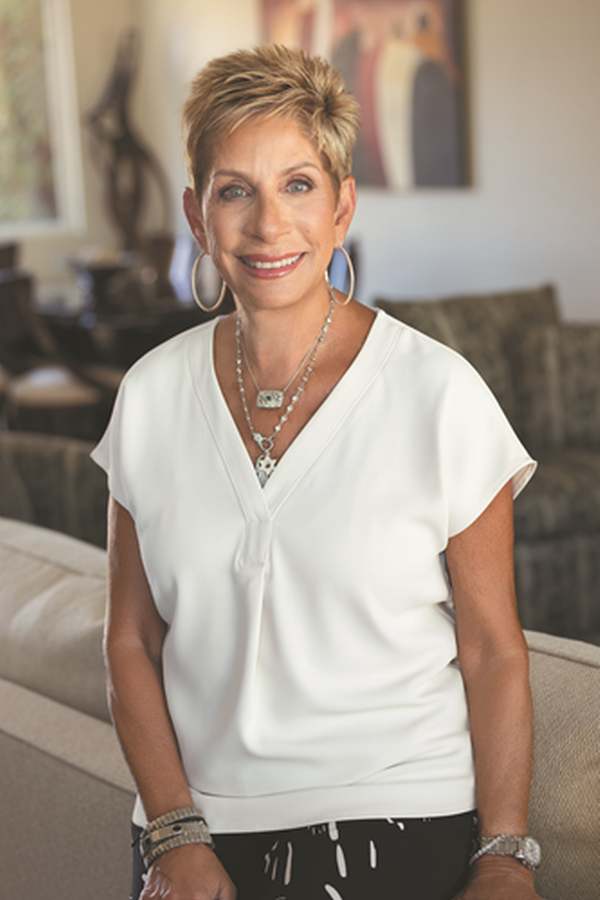
WHEN SHERRY GONNELLO MET with her new cardiologist at Eisenhower Desert Cardiology Center, she expected to get the results of her heart checkup, having been diagnosed a decade before with atrial fibrillation (irregular heartbeat).
She did not expect to hear Ehete M. Bahiru, MD, tell her, “I saw something on your lung, a small nodule. It doesn’t look right to me.”
Dr. Bahiru promptly sent Gonnello to internist Natasha Creighton, MD, who, also concerned, referred Gonnello to interventional pulmonologist Sevwandi De Silva, MD. Armed with scans of Gonnello’s left lung, Dr. De Silva told her the small firm lump looked “suspicious” and needed to be biopsied.
“My first reaction was a few tears,” Gonnello says, “because I had just turned 75 and my dad, who died at 75 of a major heart problem, also had lung cancer.”
Having passed that milestone, she thought she would outlive everyone in her family. But Gonnello, a 25-year resident of Palm Desert, believes in facing challenges head on.
“You have to do what you have to do to stay healthy,” she says.
Time-Saving Procedure
Gonnello listened closely as Dr. De Silva told her about a leading-edge procedure available at Eisenhower Health that could give her both an immediate answer and eliminate the possibly malignant nodule in a two-part surgery.
The single anesthesia bronchoscopy and resection event (SABRE) integrates robotic bronchoscopy - used for diagnosing and dye-marking lung nodules - with robotic thoracic surgery to remove the cancerous tissue in one streamlined procedure. Among the advantages: a rapid diagnosis and treatment of lung cancer, which leads to reduced hospital visits and recovery time.
The SABRE is especially suited for patients with Stage 1 lung cancer.
“Our goal is to detect cancer at Stage 1,” says Dr. De Silva, “get it out at Stage 1, prevent any spread and call the patient ‘cured.’”
Time is of the essence, however, as cancer typically doubles in size in about 90 days.
“We don’t want a patient like Sherry to wait that long because she then has a higher risk of her cancer spreading and becoming Stage 3 or 4, which would mean she may no longer be a candidate for surgery or resection.”
Gonnello smoked as a young woman but had quit about 45 years ago.
She had no symptoms of lung cancer, but she had her family history - and women have a higher risk than men of the disease - all of which gave her multiple risk factors.
Dr. De Silva told Gonnello that lung biopsies sometimes have false negatives and some benign nodules can turn malignant over time. She asked if Gonnello wanted the nodule removed even if the biopsy didn’t show cancer. “Yes” came her reply.
“I wanted it out of my body,” Gonnello says.
First, Dr. De Silva conferred with Joseph Wilson, MD, FACS, Board Certified in Cardiothoracic Surgery. He agreed with Dr. De Silva’s assessment and would perform the surgery. The two would work as a team for the SABRE in diagnosis and removal of the nodule.
On the day of surgery, March 20, 2025, Dr. De Silva threaded a bronchoscope - a thin, flexible tube with a camera - through Gonnello’s airways to obtain a tissue sample. A waiting pathologist then analyzed the sample, which revealed atypical cells that were highly suspicious for cancer.
Dr. De Silva injected a fluorescent green dye into the area that would make the cancerous tissue and healthy tissue surrounding it more visible during surgery.
Dr. Wilson then stepped in, commandeering the advanced da Vinci robotic surgical system, including its Firefly® fluorescence imaging, which helps visualize the fluorescent green dye. He removed a segment of Gonnello’s left lung, along with a handful of nearby lymph nodes to help determine if the cancer had spread.
Welcoming a Fresh Start
Following the operation, Gonnello was informed about the pathologist’s report. Later, she also learned that there were no further signs of cancer.
“Every time I say ‘Stage 1 cancer,’ I get goosebumps,” says Gonnello. “Because if Dr. Bahiru hadn’t noticed it, it probably would have gone to a further stage and I could have been in real trouble. I am so grateful to all the doctors who helped me through this.”
Told to expect a two-to-four week recovery, she told her doctors, “I have to be better in two weeks because I am being bat mitzvahed.”
She missed the opportunity six decades earlier when her parents gave her a choice between a Bat Mitzvah or a Sweet 16 party and chose the latter. Now, she spent her recovery time in bed studying the Torah. A week after surgery, she was out shopping for a new suit for the big event - a Bat Mitzvah at 75 years old.
Gonnello is an avid traveler - both on her spin bike at home and on trips with her husband, John Gonnello. Together, they regularly volunteer with the FIND Food Bank.
Her Eisenhower Health doctors will follow her scans in coming years, but Gonnello is confident she will have plenty of time, she says, “for doing all the things I love.”
For more information about the Eisenhower Health Lung Cancer Screening Program,
visit EisenhowerHealth.org/Lung.


