


EMRAP
FOR ANYONE WHO has navigated the ever-increasing competitive landscape of university applications, the desire to stand out from the crowd is as important as stellar academics and testing scores. For medical school, recent college graduates could argue it’s even more difficult.
In its sophomore year at Eisenhower Health, the Eisenhower Medical Research Associate Program (EMRAP) is bridging that gap, creating an opportunity for local undergraduate students to experience the medical field firsthand inside the hospital at the main campus in Rancho Mirage. Through EMRAP, students will not only gain invaluable clinical and research experience, but also access mentorship from directors of the program to staff physicians, residents and now, second-year EMRAP cohort veterans.
“When you apply to medical school, you not only need strong academics like GPA [grade-point average] and MCAT [Medical College Admissions Test®] scores, but you also need clinical experience,” explains Victor Cisneros, MD, MPH, Co-Director of EMRAP, and Director of Community Health Outreach, Eisenhower School of Graduate Medical Education.
Dr. Cisneros also serves as faculty for the Department of Emergency Medicine at Eisenhower Health and the University of California, Riverside (UCR) School of Medicine. His firsthand knowledge of reviewing medical school applications for the UCR School of Medicine is what drives him to promote EMRAP both at Eisenhower and to aspiring physicians.
The School of Medicine at UCR received about 7,000 applicants for approximately 90 spots, says Cisneros. With the competitive
acceptance rate at UCR and at medical schools in general, it’s imperative to be a well-rounded applicant.
“Students need opportunities not only to gain clinical exposure by shadowing physicians, but also to engage in an academic
experience that goes beyond grades and test scores. This includes access to research and publication opportunities, which are essential for developing the skills and confidence to succeed in medicine,” adds Dr. Cisneros.
“Until now, students in the Coachella Valley had no opportunities like this. This is the first program of its kind, and we’re proud to be the only hospital system in the valley leading it. As a member of the UCR School of Medicine admissions committee, I’ve seen firsthand how disadvantaged our local pre-health students are. Too often, they’ve had to travel one to two hours outside the valley to access the kind of academic environment that provides robust clinical and research experiences. This program brings those opportunities home.”
“Because Eisenhower Health already provides a strong teaching environment,” Cisneros continues, “undergraduate students
can learn the fundamentals of clinical research while also developing workforce skills that prepare them to become future physicians. And the best part is, they can now gain this experience right here in their own backyard.”
In its inaugural year, EMRAP received 40 applications for seven spots. Five of those students are now starting medical school, four of whom began during summer 2025 at UCR’s School of Medicine. Two are returning this year in a leadership role for EMRAP’s second cohort, which received an incredible uptick in applications at 165 for 10 spots.
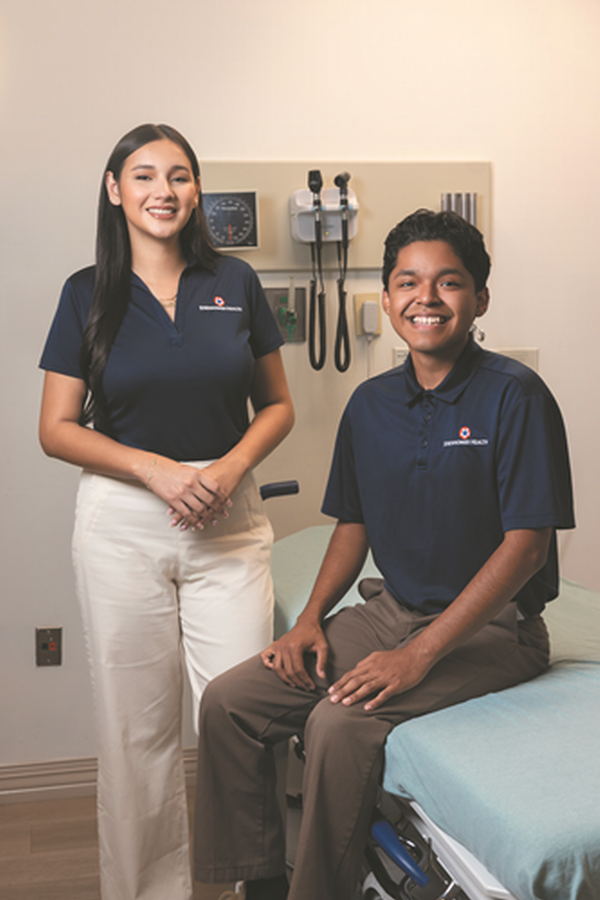
Lysdie Espinoza and Pedro Lezama-Garcia both chose to return to EMRAP for a second year. They are each pursuing a career in medicine through UCR and are utilizing both the research and clinical experience as well as the mentorship from those they work with to ready for medical school.
Espinoza moved from Los Angeles County to Moreno Valley to attend community college and continued at UCR for a Bachelor of Science in Biology, graduating in June 2024.
She began EMRAP in July 2024 and completed the program; however, she decided to take an extra year to prepare for the MCAT and apply to medical school while she continues to engage in clinical research and sharpen her writing and critical-thinking skills.
“I want to stay here for medical school and I picture my entire career here. I feel connected to this community, especially seeing firsthand the health care challenges,” says Espinoza, now 25 years old. “A lot of the people have come from different cultures, different countries, and it’’s really nice when we have patients who I can relate to with that struggle. Those patients are usually super grateful. They’’re just happy to know that someone is there who either speaks their language or even to have someone that understands their journey and how difficult it can be sometimes to just access health care.”
Lezama-Garcia echoes the same sentiment, with a strong reverence for the Coachella Valley and an intention to return and practice as a family medicine physician locally.
Born and raised in Indio, graduating from Indio High School in 2022 and studying biology with a minor in education at UCR, the opportunity to gain clinical research experience through the lens of the Coachella Valley as well as mentorship brought him back for a second year while working to complete his final year of studies.
The child of immigrants and the first to graduate high school, his first exposure to the medical field at a career day interested Lezama-Garcia with a promise of a steady, high income. A year later, his grandmother was diagnosed with cancer and he discovered the field of medicine as an avenue to provide care. Now, he wants to bridge the gap in health care with cultural sensitivity and address the lack of access due to language barriers.
At age 21, he is on track to his goal, with early acceptance to the UCR School of Medicine.
“I’m really grateful for all the mentorship,” he says. “My success is thanks to them.”
“Students might want to be lawyers, engineers or doctors, but many times have no idea how to get there,” says Dr. Cisneros. “If you are a first-generation college student, you might not have that immediate mentorship in your family or close friends. This program offers them mentorship and support they need to turn those dreams into real, achievable goals.”
“I always knew I wanted to be a doctor since I was a kid; however, saying you want to be a doctor versus actually being in the emergency department or shadowing a physician and getting to know what the actual responsibilities are, it’’s definitely eye opening,” says Espinoza. “Having the opportunity to work directly with physicians has really solidified me wanting to pursue this goal.”
“Honestly, I feel so happy when I’’m at the hospital and I know sometimes people are like, ‘But you’’re at the hospital all day or seeing patients all day,’” Espinoza continues. “But it’’s true. I’’m thinking about pursuing surgery and when people tell me how rigorous it is, how time consuming it is, I always answer with, ‘There’’s nothing else I would rather do.’”
A CLOSER LOOK
- In the first cohort, EMRAP students collaborated with residents and faculty across Emergency Medicine, Internal Medicine, Family Medicine, Cardiology, Endocrinology, Geriatrics, Dermatology and Pediatrics.
- Students worked on projects that ranged from aortic aneurysm and dissection case reports to a bee sting case report, a retrospective study on testosterone and cardiovascular outcomes, a randomized control ultrasound study, and geriatric allergy
and dermatology collaborations.
- Students actively contribute to resident and faculty projects by conducting literature reviews, collecting and analyzing data, and assisting with manuscript development.
- Of the seven students in the first cohort, about 50% were from the Coachella Valley, the remaining from the Inland Empire.
- Of the 10 students in the second cohort, 40% are from the Coachella Valley, the remaining from the Inland Empire.
Visit GME.EisenhowerHealth.org/EMRAP for more information.FOR ANYONE WHO has navigated the ever-increasing competitive landscape of university applications, the desire to stand out from the crowd is as important as stellar academics and testing scores. For medical school, recent college graduates could argue it’s even more difficult.
In its sophomore year at Eisenhower Health, the Eisenhower Medical Research Associate Program (EMRAP) is bridging that gap, creating an opportunity for local undergraduate students to experience the medical field firsthand inside the hospital at the main campus in Rancho Mirage. Through EMRAP, students will not only gain invaluable clinical and research experience, but also access mentorship from directors of the program to staff physicians, residents and now, second-year EMRAP cohort veterans.
“When you apply to medical school, you not only need strong academics like GPA [grade-point average] and MCAT [Medical College Admissions Test®] scores, but you also need clinical experience,” explains Victor Cisneros, MD, MPH, Co-Director of EMRAP, and Director of Community Health Outreach, Eisenhower School of Graduate Medical Education.
Dr. Cisneros also serves as faculty for the Department of Emergency Medicine at Eisenhower Health and the University of California, Riverside (UCR) School of Medicine. His firsthand knowledge of reviewing medical school applications for the UCR School of Medicine is what drives him to promote EMRAP both at Eisenhower and to aspiring physicians.
The School of Medicine at UCR received about 7,000 applicants for approximately 90 spots, says Cisneros. With the competitive
acceptance rate at UCR and at medical schools in general, it’s imperative to be a well-rounded applicant.
“Students need opportunities not only to gain clinical exposure by shadowing physicians, but also to engage in an academic
experience that goes beyond grades and test scores. This includes access to research and publication opportunities, which are essential for developing the skills and confidence to succeed in medicine,” adds Dr. Cisneros.
“Until now, students in the Coachella Valley had no opportunities like this. This is the first program of its kind, and we’re proud to be the only hospital system in the valley leading it. As a member of the UCR School of Medicine admissions committee, I’ve seen firsthand how disadvantaged our local pre-health students are. Too often, they’ve had to travel one to two hours outside the valley to access the kind of academic environment that provides robust clinical and research experiences. This program brings those opportunities home.”
“Because Eisenhower Health already provides a strong teaching environment,” Cisneros continues, “undergraduate students
can learn the fundamentals of clinical research while also developing workforce skills that prepare them to become future physicians. And the best part is, they can now gain this experience right here in their own backyard.”
In its inaugural year, EMRAP received 40 applications for seven spots. Five of those students are now starting medical school, four of whom began during summer 2025 at UCR’s School of Medicine. Two are returning this year in a leadership role for EMRAP’s second cohort, which received an incredible uptick in applications at 165 for 10 spots.
Lysdie Espinoza and Pedro Lezama-Garcia both chose to return to EMRAP for a second year. They are each pursuing a career in medicine through UCR and are utilizing both the research and clinical experience as well as the mentorship from those they work with to ready for medical school.
Espinoza moved from Los Angeles County to Moreno Valley to attend community college and continued at UCR for a Bachelor of Science in Biology, graduating in June 2024.
She began EMRAP in July 2024 and completed the program; however, she decided to take an extra year to prepare for the MCAT and apply to medical school while she continues to engage in clinical research and sharpen her writing and critical-thinking skills.
“I want to stay here for medical school and I picture my entire career here. I feel connected to this community, especially seeing firsthand the health care challenges,” says Espinoza, now 25 years old. “A lot of the people have come from different cultures, different countries, and it’’s really nice when we have patients who I can relate to with that struggle. Those patients are usually super grateful. They’’re just happy to know that someone is there who either speaks their language or even to have someone that understands their journey and how difficult it can be sometimes to just access health care.”
Lezama-Garcia echoes the same sentiment, with a strong reverence for the Coachella Valley and an intention to return and practice as a family medicine physician locally.
Born and raised in Indio, graduating from Indio High School in 2022 and studying biology with a minor in education at UCR, the opportunity to gain clinical research experience through the lens of the Coachella Valley as well as mentorship brought him back for a second year while working to complete his final year of studies.
The child of immigrants and the first to graduate high school, his first exposure to the medical field at a career day interested Lezama-Garcia with a promise of a steady, high income. A year later, his grandmother was diagnosed with cancer and he discovered the field of medicine as an avenue to provide care. Now, he wants to bridge the gap in health care with cultural sensitivity and address the lack of access due to language barriers.
At age 21, he is on track to his goal, with early acceptance to the UCR School of Medicine.
“I’m really grateful for all the mentorship,” he says. “My success is thanks to them.”
“Students might want to be lawyers, engineers or doctors, but many times have no idea how to get there,” says Dr. Cisneros. “If you are a first-generation college student, you might not have that immediate mentorship in your family or close friends. This program offers them mentorship and support they need to turn those dreams into real, achievable goals.”
“I always knew I wanted to be a doctor since I was a kid; however, saying you want to be a doctor versus actually being in the emergency department or shadowing a physician and getting to know what the actual responsibilities are, it’’s definitely eye opening,” says Espinoza. “Having the opportunity to work directly with physicians has really solidified me wanting to
pursue this goal.”
“Honestly, I feel so happy when I’’m at the hospital and I know sometimes people are like, ‘But you’’re at the hospital all day or seeing patients all day,’” Espinoza continues. “But it’’s true. I’’m thinking about pursuing surgery and when people tell me how rigorous it is, how time consuming it is, I always answer with, ‘There’’s nothing else I would rather do.’”
A CLOSER LOOK
- In the first cohort, EMRAP students collaborated with residents and faculty across Emergency Medicine, Internal Medicine, Family Medicine, Cardiology, Endocrinology, Geriatrics, Dermatology and Pediatrics.
- Students worked on projects that ranged from aortic aneurysm and dissection case reports to a bee sting case report, a retrospective study on testosterone and cardiovascular outcomes, a randomized control ultrasound study, and geriatric allergy
and dermatology collaborations.
- Students actively contribute to resident and faculty projects by conducting literature reviews, collecting and analyzing data, and assisting with manuscript development.
- Of the seven students in the first cohort, about 50% were from the Coachella Valley, the remaining from the Inland Empire.
- Of the 10 students in the second cohort, 40% are from the Coachella Valley, the remaining from the Inland Empire.
Visit GME.EisenhowerHealth.org/EMRAP for more information.


