


Solving the Puzzle
Numbness and weakness in Elaine Rico’s arms and legs had become her way of life in post-retirement. At first attributing those symptoms to aging, and a subsequent misdiagnosis, she eventually found relief through a correct diagnosis and cervical spine surgery at Eisenhower Desert Orthopedic Center (EDOC) in Rancho Mirage.
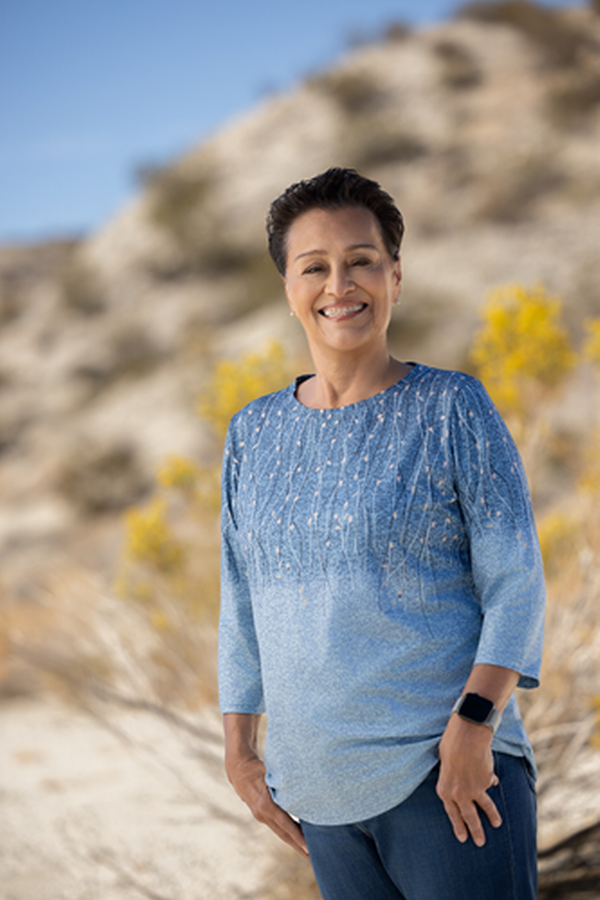
“I loved my job,” she says. “I loved high school.”
Initially, she blamed the developing weaknesses on getting older. Two years prior, the gradual loss of sensation in her left arm had led her to a Nevada physician who ordered a nerve conduction study, a test to evaluate nerve function. She was diagnosed with carpal tunnel syndrome - surgery followed, improvement didn’t.
“It kept getting worse,” she says. “I thought, my nerves aren’t coming back - something is seriously wrong with me.”
Over time, she experienced difficulty walking, but even after a full left knee replacement, her gait didn’t improve.
Rico and her boyfriend returned to Southern California, making their home in Desert Hot Springs. The move brought Rico to a new primary care physician, one who recognized there was more to her problems than carpal tunnel syndrome.
The physician ordered a cervical spine MRI and scheduled an appointment in June 2025 with A. David Tahernia, MD, a Board Certified Orthopedic Surgeon, who is fellowship-trained in Orthopedic Spinal Surgery. Dr. Tahernia is chairman of Desert Orthopedic Center and director of the Center’s Comprehensive Spine Center.
“Her primary care doctor recognized she had a serious problem with her cervical spine,” Dr. Tahernia says, describing Rico’s condition as one that is often underdiagnosed, especially in older patients. The cervical spine is the first seven vertebrae of the spine — more commonly referred to as the neck.
“It’s important to be treated sooner,” he says. Without surgery, Rico would have continued to lose mobility and become further disabled, possibly even partially paralyzed.
“The spinal cord at the cervical level controls all motor and sensory functions,” he explains, including the ability to use the arms and legs, to sense warmth and to control the bladder.
He advises patients not to wait to be evaluated for cervical spine issues if they experience numbness, tingling and weakness that limit their ability to perform daily activities or tasks.
“(Rico) had off-and-on symptoms for about two years, and over the last year it had gotten worse,” he says.
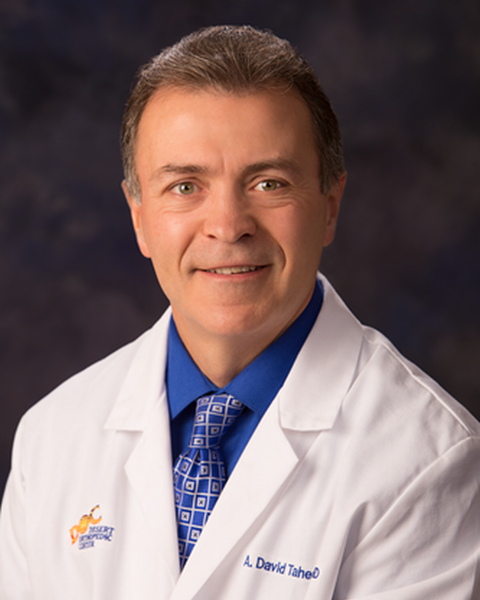
“There are a lot of symptoms patients chalk up to getting older,” Dr. Tahernia says. “With all symptoms together, as a constellation, the first thing I do is evaluate the cervical spine to rule out any spinal compression.”
Before seeing Rico, Dr. Tahernia reviewed her MRI and talked to her primary care physician. Shortly after his examination, Dr. Tahernia performed cervical spinal surgery on Rico to relieve the pressure from arthritic bone spurs compressing her spinal cord.
“Surgery involves taking out the disc spaces and removing whatever is pressing on the spine, addressing every level the surgeon feels is symptomatic,” he says. Disc spaces function as shock absorbers between the spinal vertebrae.
“In her case, when you take the disc out you have to fill the void.” Typically, Tahernia says, “that involves inserting a cage with a bone graft into the void that was left when you decompressed the spinal cord.”
Rico underwent a four-level cervical fusion. The procedure involves decompressing the spinal cord, putting in spacers, and then inserting a titanium plate on top of the spinal column to stabilize the segments that were operated on.
For such surgeries, “It’s advantageous to approach the cervical spine from the front of the neck,” Dr. Tahernia says. “Recovery is quicker and the spurs can be removed directly with this approach,” he says.
Surgery left little scarring, for which Rico is appreciative. She is equally grateful for her care under her surgeon’s supervision.
“For me, it was so easy,” she says. “The hospital, everybody was so nice, so sweet. The next day I got up and started walking. I couldn’t believe how much that pressure was affecting my ability to walk. It seemed like a miracle.”
It could take a year for Rico to see maximal gains as she recovers, but Dr. Tahernia has already seen improvement in her gait, and Rico feels less numbness and tingling in her arms.
“I can’t explain how much of a change there is,” Rico says. “I’m so happy to be able to walk. My life has changed so much from one operation.”
To learn more about Eisenhower Desert Orthopedic Center, visit EisenhowerHealth.org/DesertOrtho.
For an appointment, call 760.773.4545.


