


Breaking Barriers
Stanley Mallard has lived with chronic pain for years. In and out of the hospital, he is now permanently disabled and uses a wheelchair. While receiving care at the Eisenhower Mike and Jan Salta Health Center, Mallard discovered the innovative outpatient services offered through Eisenhower Health’s Spiritual Care department.
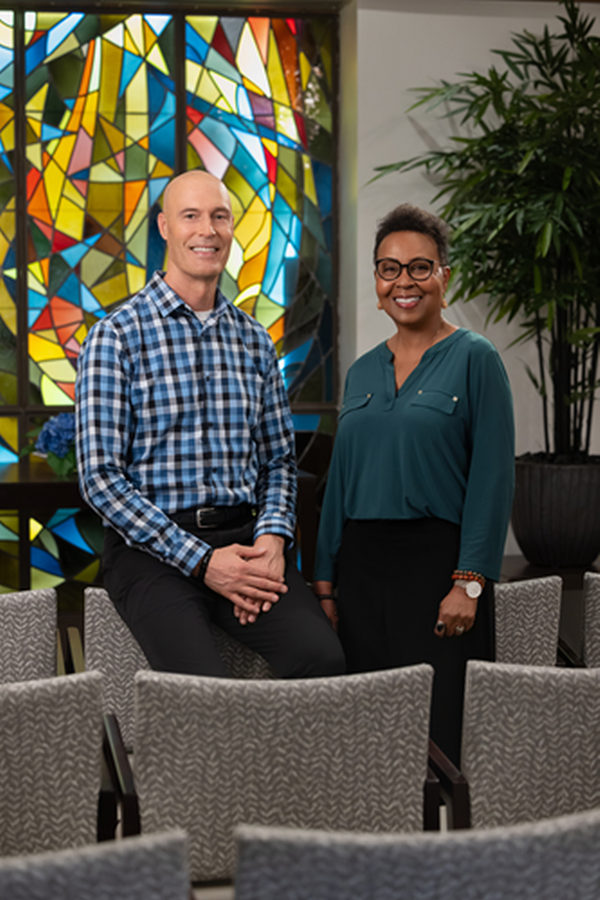
Eisenhower Health officially launched its ambulatory/virtual spiritual care program in February 2025 through Eisenhower Lucy Curci Cancer Center. The Rev. Frances Hartdige, Eisenhower’s Ambulatory Chaplain, oversees the outpatient program, which offers counseling and spiritual care via telehealth either by phone or video.
The program has since expanded to other outpatient clinics within Eisenhower Health, embracing patients like Mallard. By mid-summer 2025, the Rev. Hartdige and her team had logged 424 visits, serving 68 patients.
“Traditionally, spiritual care is focused on the hospital,” says the Rev. Jeff Bert, Director, Spiritual Care, Eisenhower Health, “but we needed to find a way to bring spiritual care to those outpatients we serve.”
The hospital sees tens of thousands of patients annually, but there are many more patient encounters on an outpatient basis.
“With this program, people can participate from the comfort of their homes,” adds the Rev. Bert.
Eisenhower Health is committed to providing whole-person care, which means caring for patients’ emotional and spiritual wellbeing, as well as their physical health.
“Our intention is to meet the holistic needs of all of our patients - both in the hospital and outpatient settings,” says the Rev. Bert.
“I wanted to reach out to spiritual care to try to close doors and open new windows,” says Mallard, 64, and a Palm Springs resident.
“I didn’t know what to expect from this little journey. It moved me so much,” he adds. “I think they really hit it out of the park.”
The Spiritual Care department’s staff of five - and soon to be six - full-time chaplains and two part-time chaplains oversees Eisenhower’s patients within the hospital and through its outpatient clinics. Chaplains are referred to as spiritual care counselors in outpatient care.
Patients interested in the virtual spiritual care program are enrolled in six sessions. They begin by taking a spiritual assessment, says the Rev. Hartdige, to measure things such as what is meaningful to them at this stage of their medical journey and what they value spiritually. Scores indicate their level of spiritual distress. The higher the score, the higher the level of distress.
“The hope is that at the end of the sixth session, we see that score decreasing,” she says. And indeed, results have shown an impressive drop of 37% in spiritual distress among patients participating in the program.
“In the hospital, you see patients within a short window of time. In this environment, we have extended visits with patients,” adds the Rev. Hartdige.
The Rev. Bert believes expanding spiritual care beyond in-patient services places Eisenhower’s Spiritual Care department at the forefront of chaplaincy programs in similar health care systems.
The benefits are profound for patients like Mallard, who says that working with the Rev. Hartdige has helped him close doors from his past and open his eyes to what is around him.
“This whole journey of living with pain, being wheelchair-bound, I’m doing this (counseling) for other people,” Mallard says. “If you lift yourself up, others get lifted up. She really made me see that.”
At Eisenhower, spiritual care services are free of charge, confidential, and can be scheduled at the patient’s convenience.
“With health care chaplaincy, we aim to meet people wherever they are, whether they consider themselves religious or not,” the Rev. Bert says. “We don’t come with any agenda. Sometimes we just provide emotional support. Other times, care might include prayer and resources appropriate for their beliefs and needs.”
For more information, visit EisenhowerHealth.org/SpiritualCare or call 760.773.1815.


