


Eisenhower Neurosurgery Clinic
Merrill A. Haas is one of the first patients to benefit from the expanding complement of services at Eisenhower Neurosurgery Clinic.
A longtime Coachella Valley resident, Haas, 84, led an active lifestyle, playing golf and tennis near her Palm Desert home until increasing health concerns brought those activities to a halt. A series of strokes led to Haas undergoing an extracranial-intracranial (EC-IC) arterial bypass in April 2025.
The bypass is the first surgery of its kind at Eisenhower Health, says Javed Siddiqi, MD, Board Certified Neurosurgeon and founder of the Arrowhead Neurosurgical Medical Group, who assisted Stephen Shafizadeh, MD, Board Certified Neurosurgeon, in performing the surgery.
Building a world-class neurosciences program that includes complex and advanced surgical procedures such as the one performed on Haas is the goal of Dr. Siddiqi and Eisenhower Health leadership.
“My mission is within two years to advance Eisenhower to receive a national accreditation as a comprehensive stroke center,” he says. Currently, Eisenhower Health is an advanced primary stroke center.
“Additionally, I would like to help facilitate Eisenhower Medical Center becoming a Level 2 trauma center designated by the American College of Surgeons. We want to be world class in these different areas.”
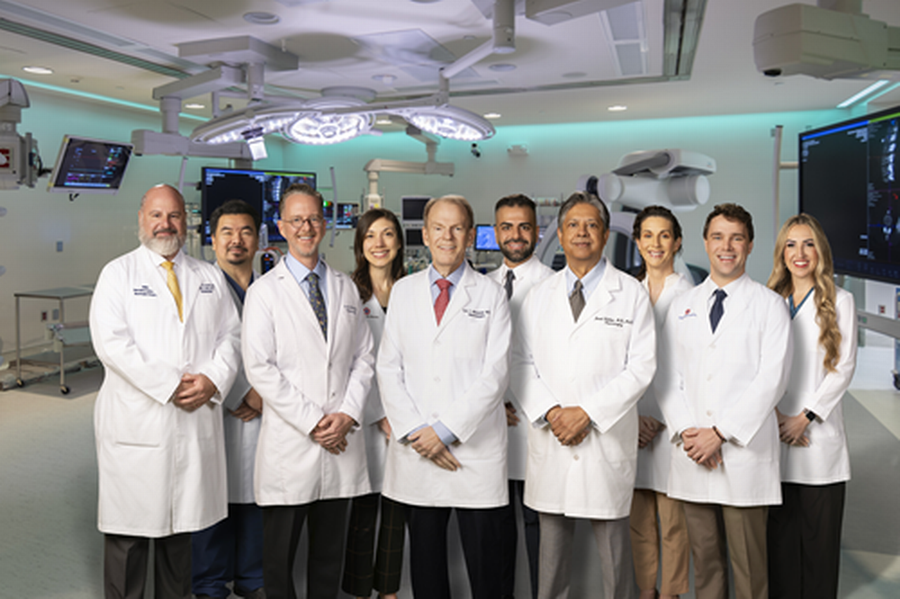
The eight neurosurgeons overseen by Dr. Siddiqi at Eisenhower Neurosurgery Clinic are faculty in neurosurgery residency training programs founded by him at Riverside University Health System in 1999 and Arrowhead Regional Medical Center in 2015. Both are nationally accredited programs and have graduated dozens of neurosurgeons.
“Because we are academic physicians and not just doing neurosurgery but training neurosurgeons, the happiest day of my year is the day I sign a certificate saying that a resident has completed seven years of training with us and is now a neurosurgeon,” he explains.
The hospital-based practice at Eisenhower Health is convenient for surgeons, staff and patients alike.
“The clinic is at the hospital. We’re minutes away from the operating room. It’s very convenient and it’s the way we like it,” he says.
As for Haas, she says she made the decision, in consultation with her sister, to have the surgery when it became clear strokes would continue without it. Blood flow tests had showed decreased blood flow in one side of the brain.
“We wanted to increase the blood flow to that side, with the obvious understanding that it carries risk,” explains Dr. Shafizadeh, the primary surgeon for the procedure. Dr. Shafizadeh has advanced neurosurgical training in skull base and open cerebrovascular surgery.
With EC-IC bypass, a blood vessel is taken from the scalp, the skull is opened and the vessel transposed into the brain, then the skull is replaced on top of the vessel.
“The goal is to maintain blood flow in that vessel, but then over time for the brain to start parasitizing small little vessels, growing new vessels,” Dr. Shafizadeh explains. Actual surgical time is usually between three and four hours. Haas was hospitalized for a couple of weeks after surgery.
“It takes months to recreate those blood vessels,” says Dr. Shafizadeh.
“Our No. 1 goal is to stop it from worsening and then hopefully over time to have it improve.”
As Eisenhower expands its scope of practice, Dr. Siddiqi expects to see neurosurgeries for trigeminal neuralgia (chronic pain conditions in the face), pituitary (endocrine gland attached to the base of the brain) tumor resection, and skull base tumor resection, along with the vascular neurosurgeries already in practice.
Dr. Siddiqi is a leading authority in neuroscience. He is professor and chair of the Department of Surgery/Neurosurgery at the California University of Science & Medicine and served as president of the California Association of Neurological Surgeons from 2022 to 2023.
In 2025 he was elected president of the Western Neurosurgical Society, effective in September 2026. For now, he is president-elect of this international organization of neurosurgeons from the 13 western United States (including Hawaii) and the western Canadian provinces.
Haas, meanwhile, is in physical therapy to regain strength and endurance. She has occupational therapy on her hand and speech therapy to help her overcome aphasia, a speech disorder brought on by stroke and other brain injuries. She has met some of her goals, like being able to use her pool and walking about a mile daily.
Asked how she is doing post-surgery, she says: “Well, I’m alive. That’s a big thing. I was very thankful he was able to help me.”
For more information, visit EisenhowerHealth.org/Neurosurgery or call 760.610.8781.


