


Surf's Up
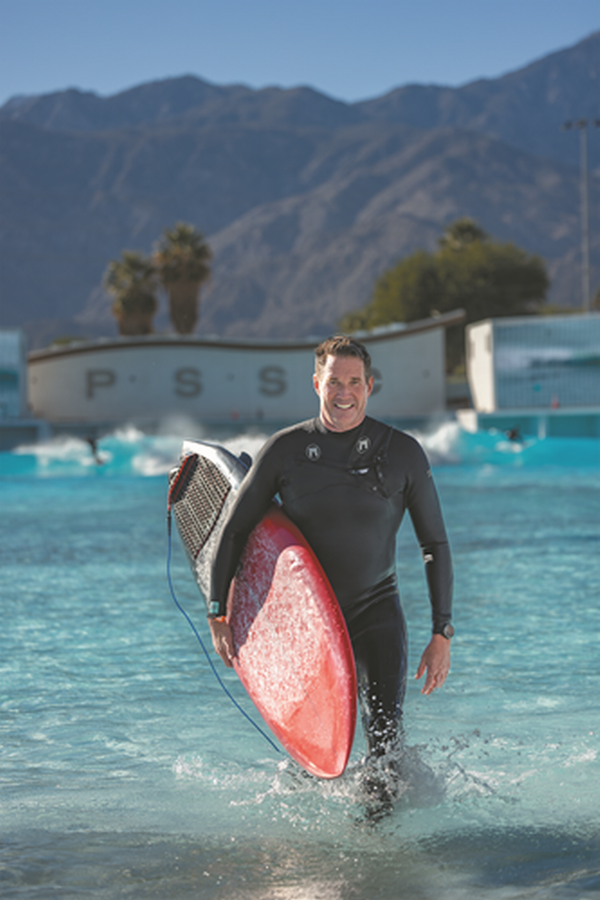
For those who have settled into the desert lifestyle but yearn for more, the Palm Springs Surf Club, with a wave technology that caters to surfers of all levels, has recently filled that void. What’s more, another venue is joining the desert landscape with construction of DSRT Surf, a 5.5-acre surf lagoon at Desert Willow Golf Resort in Palm Desert, expected to open summer 2026.
Longtime Palm Desert resident Tom Rice has been surfing for more than 50 years. Born in Hermosa Beach, the 60-year-old was introduced to surfing at a young age, and his father was inducted into the Surfer’s Walk of Fame in 2011. At age 7, Rice was given his first surfboard, leading to a lifetime of surfing, including the waves of Mexico, Fiji, Bali and Costa Rica. While he continues to travel internationally with friends and his own, now-grown, children, he is a regular at the Palm Springs Surf Club.
“There are times when the desert’s nice and sunny and everything’s good here and the beaches are gloomy and cold and there are no waves,” explains Rice of the allure of a desert surf venue.
At the Surf Club, “you have the consistency because you have a machine [creating waves],” he adds. “With the ocean, you have to take what you get.”
Rice continues to love ocean-based surfing, with the tradeoff in unpredictability leading to bigger waves.
“The natural wave in the ocean is like you’re dancing,” he explains. “It’s almost like having a partner in the water, you’re reacting when you’re dancing to what your partner is doing, right?”
And while that dance incorporates a physical endurance of remaining in paddle and pop-up (on a surfboard) shape, which includes a strong core and energy to paddle into roughly 13 to 15 waves an hour at the wave park, he also notes the mental benefits.
“When you’re going in the water and you first hop on your board and you do your first duck dive under the wave and you come out ... you’re not thinking of anything else, you’re there in the moment,” he says.
“And then when you’re in the ocean, especially, you’re totally in nature, you’re in the moment, it’s almost like a form of church. You’re just there, you feel relieved, plus you’re exercising.”
Good for the Body
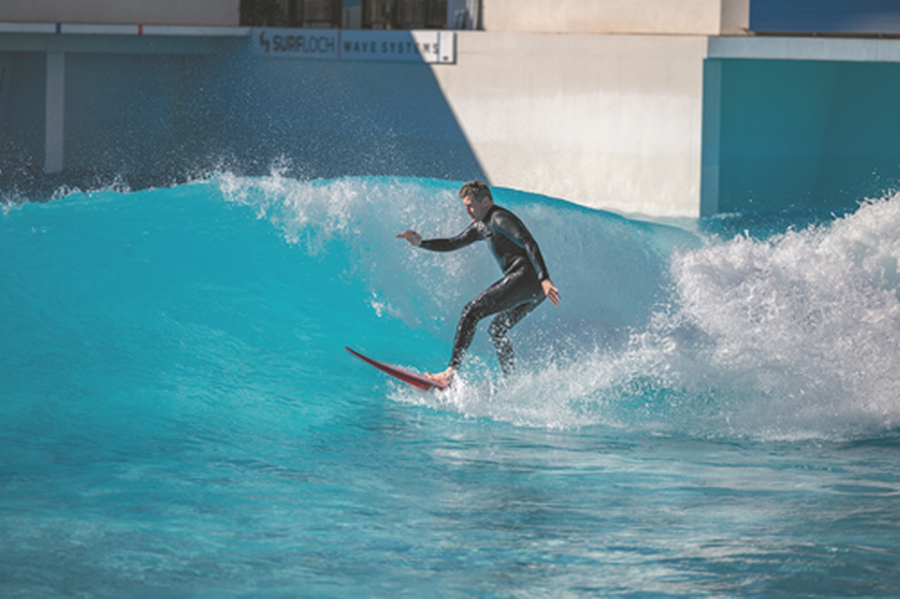
“Physically speaking, surfers are essentially strong swimmers with a keen sense of balance. Stamina and upper body strength are crucial in order to paddle from the shore through breaking waves to reach the surf line,” the researchers note in the study. “Once there, surfers wait on their boards and then paddle intensely when a quality wave presents itself. As the wave peaks, a surfer must pop up rapidly and smoothly to his or her feet from a lying down position, balancing in a fluid upright position as they glide on the breaking wave toward the shore.”
Good for the Soul
Another study, published in the National Institutes of Health’s National Center for Biotechnology Information and National Library of Medicine, examined individuals who surf and those who do not.
“The present study links the practice of surfing to a significant improvement in both dynamic and static balance, compared to other populations and different sports disciplines,” states the study. “The findings indicate that sports requiring continuous adaptation to unstable environments strengthen postural control, as is the case in surfing, snowboarding and ice hockey.”
“These observations are supported by studies describing the physiological demands of surfing, emphasizing not only the aerobic and anaerobic capacity required but also the importance of effective postural control to maintain balance on the board in constantly changing aquatic conditions.”
While that particular study didn’t find a difference in self-esteem between the two groups, there are others who are utilizing the pastime as therapy for veterans struggling with post-traumatic stress disorder (PTSD) and depression.
Johnathan Ossie published an article in Frontiers about his research in surf therapy with military veterans and its potential positive impact on physiological and psychological effects of PTSD. He worked with a California-based nonprofit, Operation Surf.
“Findings demonstrated statistically and clinically significant reductions in anxiety, depression, and PTSD symptoms immediately after the intervention and at the 30-day follow-up. These outcomes support the potential of surf therapy to improve short-term psychological functioning among military veterans.”
An All-Inclusive Sport
Rice encourages anyone to give surfing a try, noting that there are adaptations for those who have limitations.
“If you get taken to the right place and if you do the right school and it’s the right board,” he explains, “you just turn around in the whitewash and you get going forward. Even if you’re standing on the side of the board and you hop on your board last-minute and the whitewash comes and starts pushing you like a boogie board, that’s how you start to learn and then you start to stand up.”
“Anybody at any age pretty much can do it,” he adds.
Always speak with your physician when beginning a new physical activity.


