


Orthopedics: Hip and Knee
Hip and knee pain can gradually shrink a person’’s world. First, limiting exercise, then travel, sleep, work and even daily routines. Deciding when to consider joint replacement, however, can be confusing and overwhelming. Read on to recognize when it might be time for surgery, what modern joint replacement and recovery actually looks like, and how Eisenhower Health’s comprehensive program enables patients to return safely and confidently to active and healthy lives.
EXPERT TEAM
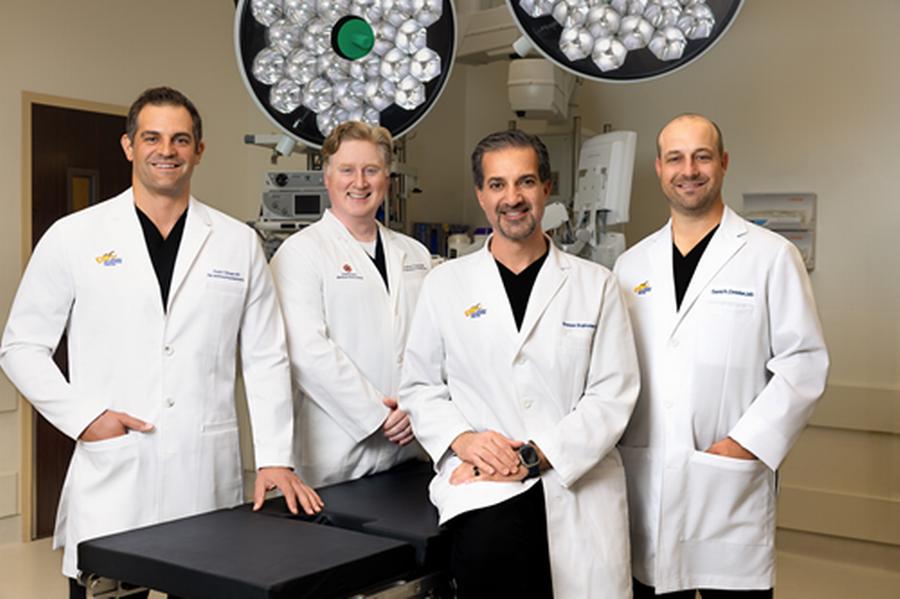
- Ghassan Boghosian, DO, Board Certified Orthopedic Surgeon, specializes in adult primary and revision joint replacement of the hip and knee. Dr. Boghosian completed his bachelor’s degree at San Diego State University, followed by a medical degree at Lake Erie College of Osteopathic Medicine in Erie, PA. He then completed an orthopedic surgery residency at South Pointe Hospital, a Cleveland Clinic Hospital, in Warrensville Heights, Ohio, where he served as chief resident. Dr. Boghosian completed his fellowship training at Cleveland Clinic in adult hip and knee reconstruction.
- Dustin Briggs, MD, Board Certified Orthopedic Surgeon, specializes in the treatment of hip and knee arthritis. He earned his medical degree from the University of Iowa Carver College of Medicine in Iowa City, Iowa, and completed his orthopedic surgery residency at the University of New Mexico in Albuquerque. He also completed a fellowship in lower extremity reconstruction at Scripps Clinic in La Jolla.
- David Christian, MD, Board Eligible Orthopedic Surgeon, specializes in primary, partial and revision joint replacement of the hip and knee. After medical school at the Keck School of Medicine of USC in Los Angeles, Dr. Christian completed his orthopedic surgery residency at McGaw Medical Center of Northwestern University in Chicago, where he served as chief resident, and an adult reconstructive hip and knee fellowship at Rush University Medical Center in Chicago.
- Erik Schnaser, MD, Board Certified Orthopedic Surgeon, specializes in adult hip and knee disorders, including pre-arthritic and arthritic conditions. He earned his bachelor’s degree at University of Southern California and attended medical school at the University of Nevada School of Medicine in Reno. He then completed a surgical internship and an orthopedic surgical residency at Case Western Reserve School of Medicine in Cleveland and a fellowship in adult hip and knee reconstruction at the Hospital for Special Surgery in New York City. Dr. Schnaser is Fellowship Director, Reconstructive Orthopedics for Eisenhower School of Graduate Medical Education. He was unavailable for the roundtable and photos.
- Justin Thomas, MD, Board Certi?ed in Pulmonary Disease, Interventional Pulmonology, Critical Care Medicine and Internal Medicine, moderated the discussion.
Dr. Thomas: Many people adapt to pain for years before deciding to seek help. What symptoms would prompt someone with hip or knee pain to seek an orthopedic evaluation and how do you confirm the joint is the source of the pain?
Dr. Boghosian: It really depends on the individual - their expectations, level of activity, pain threshold and what he or she is willing to live with. There are members of the community who don’’t want to tolerate any pain and those patients will see us much sooner. For those, we may first suggest conservative management. Other patients won’’t come to us until the severity of arthritis on an X-ray is a 10 out of 10, and for those patients, we might be more willing to proceed with surgery.
Dr. Christian: I try to phrase it as activity- and quality-of-life-limiting pain, or their hip or knee pain is driving their life, where they’’re avoiding doing what they enjoy simply because they’’re in pain. If that’’s the case, then they should have an evaluation with one of us. In terms of confirming the symptoms of the pain, most of the time it’’s by a patient’’s description of where the pain is located and what it feels like. There are specific situations where there may be some confounding variables and we have to run specific tests to confirm that it’’s coming from a hip or knee.
Dr. Thomas: Patients may experience knee and hip pain from neuropathy, spine issues or sciatica. How do you work with other specialties at Eisenhower Health to ensure successful diagnosis and treatment?
Dr. Boghosian: We have a great collaborative process with our colleagues. We utilize diagnostic testing and injections, MRIs and CAT scans, but when you start to include neurological symptoms, neuropathy and/or spinal disorders, there’’s a wonderful team of physicians at Eisenhower who help us get to the root cause of that problem. I never want to operate on a patient unless I know exactly the source of pain and we’’re going to do our due diligence in finding that cause.
Dr. Thomas: You mentioned conservative management earlier. Which non-surgical treatments should be tried first and how do patients know when those are no longer providing any meaningful benefit?
Dr. Briggs: One of the easiest treatments for us to recommend, but one of the hardest to actually do, is weight loss, conditioning and strengthening. A lot of people have debilitating or limiting pain and it is tough to increase their activity level. We understand that. We address the pain first and foremost, and then we do physical therapy for more focused strengthening. There are injections - cortisone, hyaluronic acid - or out-of-pocket options such as platelet-rich plasma (PRP). In the case of knee pain, bracing can help quite a bit, especially if you’’re having weight-bearing pain or activity-related pain. Bracing can add stability and pain relief to continue doing those activities that you couldn’’t otherwise and sometimes avoid surgery.
Dr. Thomas: What expectations can patients have for pain relief, mobility and return to activities after joint replacement?
Dr. Briggs: I call it, “The Rule of One-to-Two.” It’s a one- to two-hour operation. It’’s a one- to two-day process to go home (typically, a one-day, same-day surgery for candidates who are healthy and motivated). One to two weeks of pretty severe pain and swelling, especially with regard to knee replacement. One to two months before you’’re back to routine activities and feeling like the surgery was worth it. Finally, one to two years before the joint replacement really cools off; it can stay warm and swollen for the first year.
Dr. Thomas: Patients can encounter memorable names and strong promises online. How does a patient separate marketing language from clinical differences?
Dr. Boghosian: We have to be really careful about marketing trends versus data-proven outcomes. I tell the patient, “Don’’t pick the marketing, pick the surgeon.” Go to the doctor who you trust. Go to the doctor who you’’ve heard good things about and you know has a good reputation in the community and sit down and have a conversation with him or her. If you feel like this is a person you can enter that long-term relationship with - because that’’s what it is - becoming a surgical patient and surgical doctor to the patient, it’’s a marriage. I will take care of the patients no matter what in the long term, and they need to feel like they can look me in the eye and have an honest conversation.
Dr. Briggs: Use caution when hearing the branding with shiny names when approaches have been around for a long time and studied thoroughly. There is potentially a short-term benefit in some patients, but the long-term results are what we really care about.
Dr. Thomas: What role does robotics play in joint replacement and what benefits can it provide?
Dr. Boghosian: Robotics have come a long way in assisting the surgeon, but you have to remember that it’’s a tool and the surgeon still has to use that robot like a tool. I would pick a good surgeon without a robot over a mediocre surgeon with a robot, every time. Take it with a grain of salt because it’’s the doctor that matters most.
Dr. Briggs: I’’ve found that I’’m more proactive and can anticipate some abnormalities in surgery, as opposed to reacting to situations in surgery, when I pre-plan with the robot. Having said that, the final outcome is fairly similar. I often use the analogy of driving a car manually versus using an automatic transmission. You get to the same destination, just with a different strategy. There was a recent multi-center blinded study that showed pretty consistent outcomes with or without the robot. Interestingly, 80% of the surgeons preferred how the surgery went using the robot, but I don’’t think it affects the outcome. When we’’re using manual instrumentation, we don’’t leave the operating room until we’’re happy with that knee, even if it takes a little extra work.
Dr. Christian: It’’s a really powerful tool, but you have to know how to use it correctly. The robot’’s not doing the surgery. It’’s the surgeon who’s in charge and it goes back to picking the surgeon more so than picking the technique or the technology. I stress to all my patients that joint replacement is a marathon, not a sprint, and we’’re not doing joint replacement for the [results of the] first three weeks after surgery. We’’re doing this for the next 10, 15, 20, 30 years after surgery.
Dr. Thomas: Does robotics provide any greater technical precision and does that translate to any less pain?
Dr. Boghosian: We have 10 ortho robots at Eisenhower Health. It’s a huge investment on behalf of Eisenhower, and a huge thank you to our donors. But at the end of the day, we did that because there’’s science and data behind it; there’’s a lot of value that the robot brings. Things like haptics (creating physical sensations for users in digital environments, like a keyboard click on a cell phone), for example. It protects the soft tissue and keeps the saw blade where the blade needs to be. It gives the physician balancing data so that we can balance the knee according to what is needed for that patient’’s anatomy.
Dr. Briggs: What we’’re realizing is that the patient’’s native anatomy, even when it comes to the knee and the angle of their joint line (how that knee is constructed) is pretty variable among patients. The robot allows us to more accurately restore the native joint line, which interestingly in the studies hasn’’t really been shown to have that much difference on how the patient feels. But for me, it allows a little bit less ligament releasing and what we call “balancing.” The knee auto balances itself when you restore that joint line.
Dr. Thomas: Integrating technology as a tool, along with the surgeon’’s training, judgment, experience and ability to individualize the operation to the patient, is what is really important. In addition, I would say excellent joint replacement also depends on the entire system of care, not only what happens in the operating room. What does world-class joint replacement care mean from a patient’’s perspective and what should patients look for when comparing programs?
Dr. Boghosian: Numbers matter. If I did 10 knee replacements a month, I wouldn’’t be as good as I would be if I’’m doing 100. I do about 100 hip and knee replacements a month, which allows me the level of expertise and knowledge to do a good job every single time because I’’m doing it over and over again.
But, it’’s not just about what I do that helps the patient succeed. It’’s really about the team that’’s around me. When a pre-op or post-op patient is engaging with one of my team members, who are seeing this hundreds of times per month because there are four of us, then they have the experience and knowledge to help guide the care of that patient. Whether it’’s a physical therapist, nurse or a pre-anesthesia testing visit, the repetition helps that whole team get stronger, and that’’s what makes a world-class center of excellence.
Dr. Briggs: The resources that Eisenhower provides with regard to education is meaningful. We recorded a series of pre-surgical videos for patients that I always recommend. At the pre-anesthesia testing clinic, patients make sure their medical comorbidities (conditions) are well-controlled and learn about their medications. We have an online educational joint replacement class with a physical therapist. The class walks you through what to expect before, during and after surgery. Knowledge is power. There’’s a lot of unknowns going into this surgery, but we hope that on the day of surgery you’’ve been educated to know what to expect.
Dr. Boghosian: We use ERAS, or enhanced recovery after surgery, and it’’s something all doctors at Eisenhower in the orthopedic program embrace. It is starting with the patient months before surgery, optimizing their body, environment and mind. Sending patients to a teaching class so they know what to expect and bringing them in a week before surgery for a pre-op visit to discuss any last-minute questions. By the time the day of surgery arrives, there’’s very little anxiety, discomfort or ill-preparedness for the operation.
Dr. Thomas: How does providing this comprehensive orthopedic care benefit Coachella Valley residents?
Dr. Boghosian: Eisenhower Health was recently ranked No. 1 in the Inland Empire and No. 11 in the state for Orthopedics, as well as high performing in specifically hip and knee replacement. From a hip and knee volume standpoint, our surgeons do as much as, if not more than, surgeons anywhere in the country - partly due to the population that lives here and partly due to the caliber of the surgeons - so not a whole lot leaves the Coachella Valley. There are a lot of patients who come here for surgery from out of town - whether it’’s across state lines, Canada or different parts of the world - because of the reputation of Eisenhower.
Dr. Thomas: How are you involved in training future orthopedic specialists?
Dr. Briggs: We recently graduated our first class of orthopedic fellows. We have two fellows a year and they are specializing in hip and knee replacement, which is a kudos to Erik Schnaser, MD, the program director. He really did the heavy lifting of getting this program going. The four of us are all on the faculty to spend time with the fellows in the clinic, in the OR and pay it forward. We all did a fellowship as well and that’’s how we learned and teaching has been very rewarding.
Dr. Thomas: Can you tell us a little bit about the world-class operating suites at Eisenhower Desert Orthopedic Center?
Dr. Boghosian: I call it the Taj Mahal of orthopedics. It’’s an incredible facility of 100,000 square feet of pure orthopedics and there are state-of-the-art operating rooms with every bit of new technology that an orthopedic surgeon could hope for. But more than that, it’’s the people who are in it. There are incredible nurses, physical therapists and colleagues. The training that we’’ve gained, married with the skill set of the staff that’’s here at Eisenhower and at Eisenhower Desert Orthopedic Center, lends itself to an excellent patient outcome.
Dr. Thomas: What advances have made same-day and short-stay joint replacement possible? How does Eisenhower Desert Orthopedic Center support this model of care?
Dr. Christian: Same-day joint replacement has gained popularity across the country over the last five to 10 years. It’’s patient optimization and patient discussions preoperatively, as well as collaboration with our anesthesia colleagues, that make same-day and short-stay possible. There’’s been a transition from general anesthesia to a regional anesthesia, which allows for an easier and faster recovery after surgery. There are nerve blocks to help control postoperative pain and there’’s multimodal pain regimens. There have also been advancements in the surgical technique to help with the swelling and pain from the surgical procedure.
Dr. Briggs: It’s amazing how rapidly the shift took place. In residency about 15 years ago we kept patients four nights in the hospital and sent them home with a prescription of 100 oxycodone. Some of the change was accelerated by Covid. We were starting to ramp up outpatient surgery at that time and then Covid kept a lot of people from wanting to be in the hospital. A lot of us were apprehensive about sending patients home the same day, but our experience and the literature supports that they actually do better at home.
Dr. Boghosian: It’’s from five days to five hours. Before my time, patients used to come in a day before surgery - come in on Monday, have surgery Tuesday and then go home Sunday or Monday. Now, for a primary, uncomplicated knee replacement, a patient arrives at 7 a.m. and returns home at 2 p.m.
Dr. Briggs: Speaking of that shift, I had mentioned narcotics. We are steering away from utilizing narcotics as the foundation of pain control. There are some medications that are non-narcotic, pain-relieving medications, but also because of the nerve blocks and the focus on avoiding swelling, some patients can get through with no narcotics and others use very few of them. Sometimes it’’s necessary and we understand that, but generally speaking, I think the recovery does go more swiftly if we can avoid narcotics.
Dr. Thomas: What can patients expect on the day of an outpatient joint replacement from arrival through surgery, recovery and discharge?
Dr. Christian: I explain it as a rule of two: you get there a couple hours before surgery, surgery takes a couple hours, and then recovery for a couple hours before going home. In order to be able to go home, you have to have no nausea, blood pressure and vital signs must be normal, and you will be cleared by a physical therapist. All of that is to make sure there’’s a safe discharge and our nursing staff, especially at the surgery center and at the hospital, do a fantastic job of making sure patients get through that process seamlessly.
Dr. Boghosian: A lot of patients hear outpatient surgery and automatically experience a little bit of anxiety, "My God, I can’’t go home. I just had a knee replacement." We prepare them so well leading up to the operation that by the time the day of surgery comes, for almost all patients, that level of anxiety is significantly decreased. The other thing I like to impress upon patients is just because we’’ve discussed you going home, doesn’’t mean you’’re going to go home. You have to be comfortable in the recovery room. You have to have walked, be approved by a physical therapist, your bladder has to work and vital signs have to be fine. You have to be able to eat and drink and have no nausea or vomiting. I need to know that I could send you home with a smile on your face. If there’’s a reason to keep you, we would keep you.
Dr. Thomas: I went through several knee surgeries and remember recovery shortly thereafter involving movement and bending. What is the difference with the newer “quiet joint” protocol in recovery?
Dr. Briggs: The accelerated recovery after surgery knee protocol in the first couple of weeks after knee replacement involves a less-is-more approach. We want you to walk and be active, but overdoing it can cause a lot more pain and swelling and actually sets you back. We want patients to be motivated after surgery, but that works better if you wait two to three weeks after the surgery to let the knee cool off.
Dr. Boghosian: If you sprain your knee, we tell you to relax, stop, put it on ice and don’’t move it. Or, if you break something, we tell you to stop, relax, put it on ice and don’’t move it. And then we do a knee replacement and we say move, move, go, go. It’’s counterintuitive. You want the soft tissues to calm down, relax and let the swelling and inflammation go away.
Dr. Thomas: So, more active bending of the knee and aggressiveness can worsen this inflammation. How does that inflammation cause more pain?
Dr. Christian: Throughout a knee replacement recovery, you’’re battling pain, swelling and stiffness. Surgery is a trauma. It’’s a controlled trauma, but it’’s a pretty significant one. If you keep stressing a joint that has trauma, it’’s going to stay inflamed and swollen. The quiet knee protocol is trying to battle that initial inflammatory phase from the trauma of surgery.
Dr. Briggs: The knee is a tightly closed joint capsule and it’’s like a balloon. The more it gets distended, the more pressure there is, and the more pain receptors get triggered. It’’s that swelling and inflammation that gets tighter and tighter that we’’re trying to control.
Dr. Thomas: Are there any postoperative symptoms that prompt an urgent call?
Dr. Boghosian: Call us right away with any mechanical injuries, falls or acute changes in symptoms - if you’’re doing fine on a Tuesday and all of a sudden on a Wednesday you wake up with severe pain, or if the joint is red, hot or swollen.
Dr. Briggs: We do what’’s called a watertight closure in surgery. That closure is to ensure fluid is contained in the joint space and then the skin is closed tightly, but it’’s not uncommon to have some blood strike through occasionally on the dressing. If you start to have later onset drainage, a week or two after surgery, that’’s an emergency.
Dr. Thomas: How do the materials used for replacements affect the healing timeline?
Dr. Briggs: Historically, we would use a lot of cement fixation, or a thin layer of cement that connects the implant to the bones. In the last five to 10 years, especially with knee replacements, it’’s now transitioning to more press-fit components. It’’s initially a friction fit, and then the bone starts to heal to the metal following pretty much the same pattern of fracture healing. At a couple of weeks, it is reasonably well-fixed. By six weeks, there’s development of immature bone for a solid foundation. And by three months, it’’s pretty much normal bone. As a rule of thumb, patients get back to high activity - pickleball, golf - around an average of four months, but it’’s not uncommon to start those at two to three months if you’’re feeling like you’’re recovering well.
The materials we use now are as good as they have ever been as far as how we process the plastic spacers and the press-fit nature of the components, which we think will be better in long-term fixation. Those used to be the two weak links: the wearing out of the plastic and the loosening of the cement interface. I tell my patients there is about a 1% risk of re-operation or revision per year that accumulates over time. So at 10 years, there’’s about a 90% chance you’’re going to be doing well. At 20 years, there’’s about an 80% chance you’’ll be doing well. The younger you are, the earlier that accumulation starts and your risk of revision is going to be higher. As you age and get your joint replacement, then the likelihood it’’s going to last the rest of your life is very high.
Dr. Thomas: How do other conditions and overall health - smoking, diabetes, nutrition - play a role in affecting recovery?
Dr. Boghosian: Sometimes it’’s our job to tell patients “no” because we have to optimize the patient before undergoing the surgery. Oftentimes, I’’ll say, "I’’m not saying no. I’’m saying not yet.” About 20 months ago, I denied surgery to a patient who was roughly 360 pounds at 5 feet 3 inches. I told him, "This is dangerous. We should not be doing a knee replacement." He had bariatric surgery, lost 200 pounds, returned to reevaluate, and is now scheduled for a knee replacement.
Dr. Briggs: If there’’s any modifiable risk factors that we can make better before an elective surgery to improve your outcome, we should do that first.
Dr. Thomas: How can patient preparation, standardized care pathways and better coordination reduce complications, readmissions and overall costs while preserving individualized care?
Dr. Briggs: Patients need to have a good support system going into surgery. It was not uncommon historically to have patients go to a nursing facility or a rehab after surgery, but now we encourage patients to go home, whether that’’s the same day or a day or two after surgery. It’s advantageous to go home, but it takes help, whether it’’s a spouse, a child or friend, you need help two to three nights after surgery as well as someone there throughout the whole day.
Also, we prefer to be the first to find out if you’’re having a problem as opposed to urgent care or the emergency department. We want to be the ones that evaluate patients that have a problem. We would rather have patients come in and see us in the clinic.
Dr. Thomas: Is there emerging technology or any non-surgical treatments that may delay the need for surgery?
Dr. Boghosian: There’’s so much coming down the pipeline with non-surgical treatment options. Some of it is still investigational and proving itself worthwhile. Cortisone is a powerful steroid that’’s used to decrease inflammation in the knee. Viscosupplementation, or gel injections, helps to decrease pain and improve range of motion for six or so months at a time. Then, you have things like biologics and PRP, which is where you take your own blood cells and you spin them down, take the anti-inflammatory portion of those blood cells, and inject them back into a joint to see if you can decrease pain and inflammation.
I think there’’s still a lot of work being done in the stem cell world to see if we can utilize stem cells to decrease pain and minimize the progression of arthritis. One misconception is that it regrows cartilage. We haven’’t seen that yet, but if we can slow down the process of cartilage loss, that would be great.
Dr. Briggs: Intervening when the arthritis is mild or moderate is important. We still have a chance to salvage the joint at that time. Once we get bone-on-bone arthritis, it’’s pretty difficult to restore the cartilage.
Dr. Christian: There are a few invasive, but non-surgical options that can be used for arthritis symptom control. There is genicular nerve ablation, which is deadening some of the nerves around the knee to help with pain control. We collaborate with Eisenhower’s vascular surgeons for genicular artery embolization, which is coagulating some of the blood vessels around the knee to again help with symptoms. Recently emerging is low-dose radiation therapy that we are working collaboratively on with Eisenhower’s radiation oncology specialists.
Dr. Thomas: How is artificial intelligence playing a role in orthopedic surgery?
Dr. Boghosian: What we’’re finding today, at least in the robotic realm, is that right now the surgeon has to think through what he or she wants to do with the implants on the screen and navigate the position of those implants. With the future of artificial intelligence, we can take surgical poses of the knee and put that into the software and the software will report what it thinks is the most optimal position for that knee replacement, which is something we now have to think through ourselves. That’’s actually already here and will be in the next iteration of the robots we use.
Dr. Thomas: What do you estimate joint replacement is going to look like in five to 10 years?
Dr. Boghosian: There is going to be some improvement in the implant materials and robotic technologies, but what you’’re going to find in the next decade is postoperative management.
Dr. Briggs: We can get a hip replacement to feel pretty much like a native hip. Historically, we’’ve had a more difficult time achieving the same for knee replacements, but I do think that with the combination of respecting the patient’’s native joint line, some of the new implant designs and the different shape of plastic inserts, I think we’’re getting closer than we’’ve ever been to recreating a native knee.
Dr. Thomas: How does Eisenhower decide which new technologies or techniques are ready to adopt?
Dr. Boghosian: That’’s the beauty of the complexity of cases we can do here. We could do anything from as simple as a partial knee replacement to a total femoral replacement, which means you’’re taking out the whole part of the pelvis and the whole femur gets replaced all the way down to the knee. And our surgeons have a skillset to really do anything.
We have an incredible partnership and the Eisenhower administration wants the physicians to succeed. Physicians want our patients to succeed, which makes Eisenhower succeed. It’s a relationship that develops and fosters the growth of both the community, the physicians and the hospital itself.
Dr. Thomas: What would you say is the long-term vision for comprehensive orthopedic and joint replacement care?
Dr. Christian: I’’m the new surgeon here in this group and everything I’’ve learned about Eisenhower Health and the orthopedic department here is that there’’s been an incredible focus on quality. As we continue to grow, we will continue to expand our research and the teaching we do.
Dr. Thomas: In closing, for someone who has allowed joint pain to limit their life for years, what would you want that person to know?
Dr. Briggs: Most people have a wave-of-the-white-flag moment where either they can’’t sleep, they can’’t take a walk with their spouse, or they can’’t play the pickleball that adds to their social life. If you have that moment, or as Dr. Christian said, your hip or knee pain is driving your life instead of you being in the driver’’s seat, the results we achieve now in a safe environment is unmatched to anything we’’ve been able to do in the past.
To learn more about Eisenhower Desert Orthopedic Center, visit EisenhowerHealth.org/DesertOrtho. For an appointment, call 760.773.4545.


