


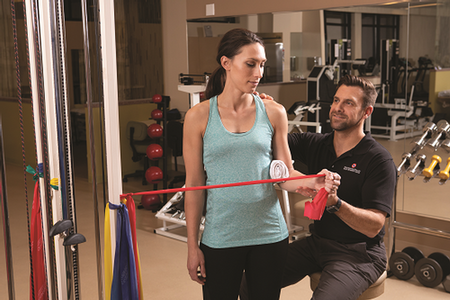
With time, our muscles age, losing mass, a result of the decreasing number and size of muscle fibers. And although this is a part of the aging process, research shows that muscles can continue to get stronger. Learning how to optimally use muscles can slow the aging process, help maintain strength, and increase flexibility, thereby decreasing potential injuries.
In particular, our shoulders carry a heavy load of responsibility for all the work they do, and with age, some of the ligaments, tendons and structures surrounding the shoulder can begin to deteriorate and fray, preventing optimal function. Although this can happen through traumatic injury, more often, normal wear and tear progresses over time.
“The rotator cuff is just as susceptible to the aging process as every other part of the body,” says Geoff Kandes, PT, DPT, Supervisor, Physical Therapy, Eisenhower Desert Orthopedic Center. “The joints wear down, the tendons weaken, and the rotator cuff muscles do not work as well.”
Symptoms of rotator cuff injuries – non traumatic
According to Kandes, people may first notice shoulder problems at night, especially if they’re lying on the shoulder that is bothering them. They may also notice pain while reaching behind their back or reaching into the back seat of a car.
“The pain often starts small, with the individual feeling it intermittently, and then the symptoms start to progress,” explains Kandes.
“Typically, I tell people that if they experience anything traumatic like a fall or any sudden pain that is continually increasing, they should see a physician.
“For milder and non-traumatic shoulder pain, I’d recommend using a cold pack as a first line of defense,” continues Kandes. “It not only helps to reduce the pain but also inflammation. It’s best to use a cold pack for 15 to 20 minutes with at least one layer of towel between the skin and the cold pack. If the shoulder improves, inflammation due to activity may have been contributing to the symptoms.”
For aches and pains that aren’t helped with conservative measures like cold packs and over-the-counter anti-inflammatory medicine, Kandes recommends seeing a physician and getting a referral to begin working with a physical therapist.
“Once a physician and physical therapist evaluate a patient, they can determine the right course of action, using stretching and strengthening exercises to help reduce the symptoms,” says Kandes.
Prevention
Just as important as seeing a physical therapist when there is a problem, it is equally as important to learn how to use proper body mechanics when exercising, especially in the gym, to prevent injury. Physical therapists can teach patients how to use their bodies in safer ways, specific to their needs.
“If an exercise becomes painful to do, don’t push through it,” says Kandes. “Get help in figuring out what specific exercises would be best for you.”
Paige Larson, Clinical Director, Physical Therapy, Eisenhower Desert Orthopedic Center, discusses physical therapy for orthopedic conditions on an episode of Eisenhower’s Living Well podcast. Visit EisenhowerHealth.org/podcasts To learn more about Eisenhower Desert Orthopedic Center’s physical therapy department, call 760.773.4545, or visit EisenhowerHealth.org/EDOC and click on Physical Therapy.
• Always test the load you’re going to lift. If possible, divide it into smaller, lighter loads.
• When carrying something, use two hands and keep the item close to your body. don’t hold anything heavy away from your body.
• Avoid lifting anything overhead if possible. Try to keep the item at shoulder level. If need be, use a sturdy ladder or step stool to put something away, rather than to lift it overhead.
• Be aware of your posture, especially when using a computer. Take breaks often, moving and stretching.


By using or otherwise accessing the website, you agree to that this website uses cookies and similar technologies, including those provided by vendors, for various purposes, such as to support website performance, features, and analytics (for example, Google Analytics). These cookies may process data such as IP addresses, including for them to function properly. Cookie vary across the website, including per webpage. For more information, see the Website Privacy Policy. Use or other access to this website is subject to the Website Terms and Conditions.
Accept ALL cookies to enhance your experience, including analytics that help us understand how our site is used. Accept Required allows only essential cookies needed for the website to function, such as session management and your cookie preferences. Accept None does not allow any non-essential cookies and no cookies are stored after your session is complete. Modify My Preferences